Interviews
Theaster Gates on Waking Up That Energetic Life
The art world’s multitasker par excellence speaks about image archives, fusing Japanese and West African traditions, and the possibilities of creation.
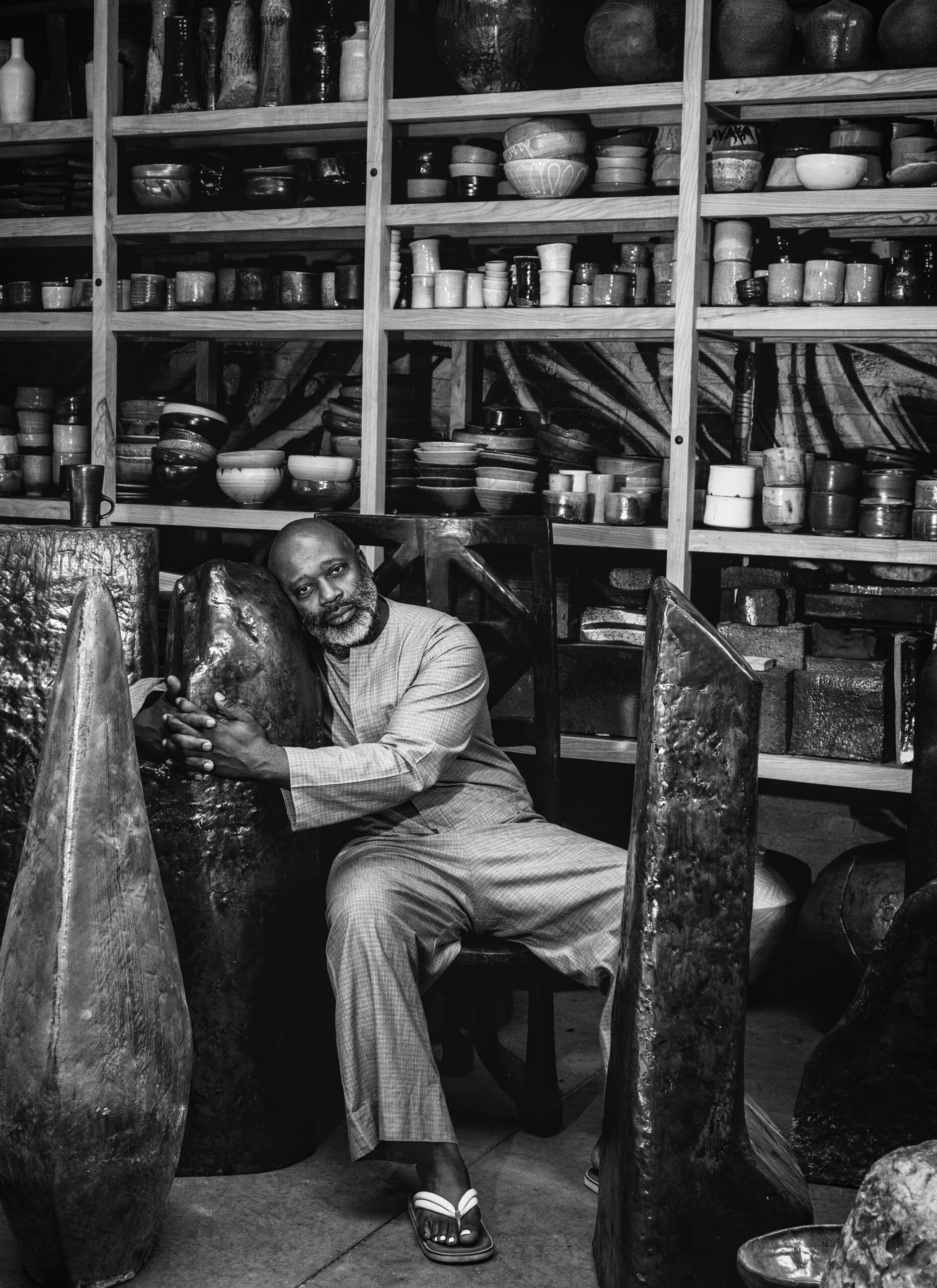
Photograph by Dana Scruggs for Aperture
“I’m tired of either/or,” says Theaster Gates. Artist, urban planner, activist, potter, archivist, gospel singer, and much else—the eminent Chicagoan has spent his career embodying the possibilities of both/and.
Uniting Gates’s efforts is a commitment to harnessing the energy of everyday materials, as exemplified by his idea of Afro-Mingei: a fusion of African American history and identity with the Japanese philosophy of mingei, which celebrates the beauty of functional objects handcrafted by anonymous artisans. Whether making installations, ceramics, or places, Gates has refused to pit craftsmanship and conceptual art against each other. For him, the lives of ordinary things are an essential thing of life.
“Can we learn to love to do things excellently?” With this question top of mind, Gates recently spoke with the curator and writer Ekow Eshun for a conversation that ranges across the past, present, and future of his art—from the work he’s done with his Rebuild Foundation transforming distressed buildings in Chicago into affordable living spaces and cultural centers, to his founding of the Black Image Corporation, to promoting the significance of clay, to envisioning what it will take to craft new platforms and paradigms for a collective Black imaginary.


Ekow Eshun: I saw you last summer at the Black artist retreat you hosted in Arles, France. You transformed the LUMA Foundation space into a site of manufacture as well as display, where you were making new clay works and then putting them on show. You talked about how you wanted to explore “the museological, political, and social possibilities of clay.” Can you elaborate on that idea of what clay represents for you?
Theaster Gates: I’ve been intentional about acknowledging the polemics of craft as a starting point for recognizing the contribution of craft to all kinds of contemporary practices, and the truth of craft within modernity. We could not have gotten to modern sculpture if it hadn’t been for someone recognizing that the same material that could be used to make a vessel for fermentation could also be used to make a torso, or a neck, or a hand. If we were to look at folk like Giacometti or Henry Moore or Barbara Chase-Riboud, if they were casting it in bronze, they were sometimes doing that from another positive, and that positive may have been directly connected to the plastic arts.
Clay has been the main stage, and artisans have not only been preoccupied with the making of the vessel, they’ve also been occupied with some notions of imaginative thought beyond the vessel. Poetry. Things done in jest in the Greek vessel. Potters making fun of each other, telling stories. Clay is as small as an art historian says it is. And if that’s the case, could I push back against the historian and say, “Oh, actually, this material is big, and it’s central to making”?
Eshun: It’s not about the finished art object. It’s the fact of making and working with the material in itself?
Gates: Yes. Rather than trying to prove that clay could do anything else, I wanted to simply represent the material and its processes, so people might draw their own opinions about the limits or the limitlessness of the idiom. The vessel is a body. It is a foot and a belly and a shoulder and a neck and a lip.

Aperture Magazine Subscription
0.00

Eshun: Let’s go back. The first time you go to Japan is 2004. Can we talk about what you discovered there in terms of the ceramic tradition, but also how you thought your art might fit into that tradition, and in relation to what you were bringing with you?
Gates: Tokoname, this small Japanese city, birthed in me three things. The first thing was that, relative to the history of this material and great makers, I am nothing. The first thing Tokoname did was it humbled me. I was an American, naive, twenty-nine-year-old sculptor who thought he was going to share how great he was, and I arrived to a town I had never heard of, with people who have no relation to the part of the world that I’m from, and I was immediately humbled by the generations of expert skill, intuition, spirituality, discipline, intention, sociability. I was humbled at how little of a man, how little of a human I was. That I hadn’t read enough poetry. I hadn’t ever worked hard and deeply enough. I wasn’t as kind and as social as I thought I was. I was actually quite selfish. And my skill was bunk, relative to this great mountain that I was in front of. I needed that humility first, because that was the enzyme that broke me down, and that demonstrated that there was a lot to learn—and at twenty-nine, learning that there was a lot to learn. This is after I’ve gone to South Africa. I had a great experience there. I’ve come back. I’ve started my own artist collective.
The second thing Tokoname gave me was a hunger for learning and being a lifelong learner. Because I thought, There’s no way that I’m ever going to be as good as I want to, no matter what the newspapers tell me of a good or bad exhibition. The thing I’m chasing, people spend their whole lives chasing: one glaze color, one bowl form, trying to get spirit from wherever it comes from, through their hands and into a material form. I hungered for that kind of learning and that kind of engine for learning.
The third thing that it gave me was a sense of an aesthetic dimension that had nothing to do with the material world.
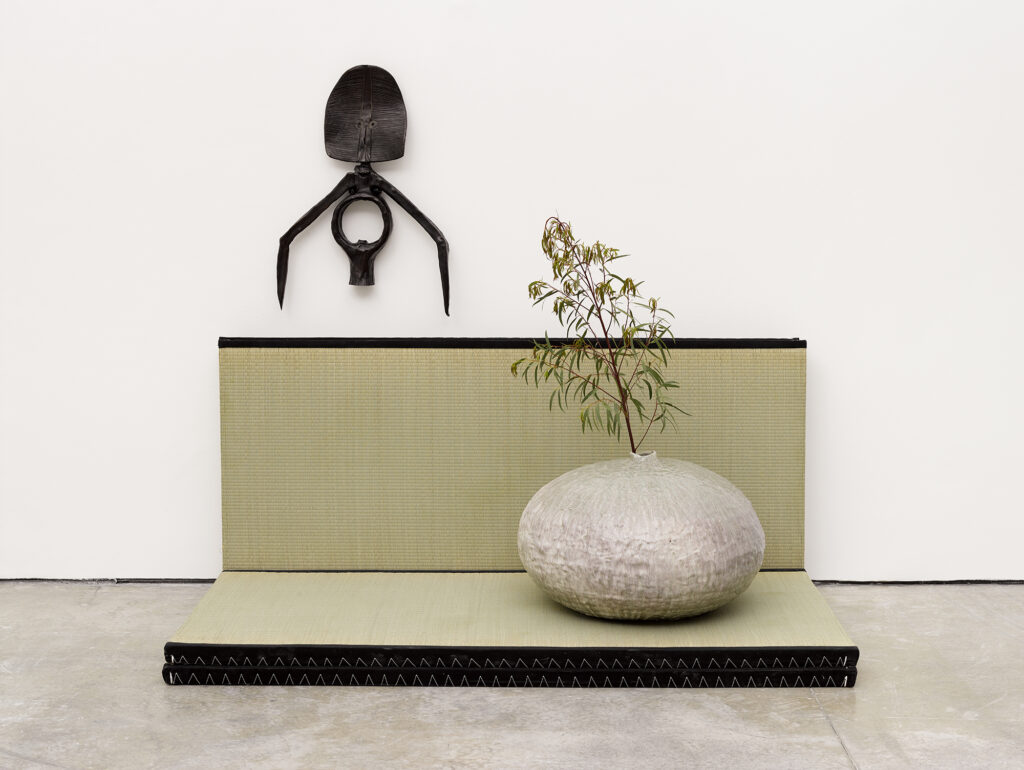
Courtesy White Cube, London
Eshun: Say more.
Gates: That while I was preoccupied with making a tea bowl, the making was actually not about tea bowls. That the pursuit, the aesthetic dimension could be akin to a spiritual dimension. That it’s a way of assigning aesthetic values to a branch—ikebana. To a textile. To the garden. To the creation of paper. To the assembly of your books. To the tying of a box. It was a way of understanding that the world lacked aesthetic dimensionality. The Industrial Revolution, the Romantic era, the age of Enlightenment gave us logic and intelligence, and they disrupted aesthetic dimensionality. And that I could spend my entire practice never making a new work, but simply assigning an aesthetic dimensionality to the objects that already exist in the world.
People talk about that in terms of “reclaimed” and “recycled,” it ain’t about that. It’s about recognizing the aesthetic potential within a preexisting thing. The reason I talk about Shintoism at all is because I’m interested in the possibility of the energetic life that might live within an object. How do we wake up that energetic life?
“If you’re going to make something, make it good. That’s a value that I’m trying to bring back from the past.”
Eshun: You’ve talked before about how you see your work, at least in part, as honoring the spirit within things.
Gates: Yes.
Eshun: But it’s that balance that’s so interesting. That, yes, there’s the spirit, but there’s also the thing in itself. And that seems as important as the feeling one finds within it.
Gates: You know, I’ve seen so often a woodworker make a beautiful table and then put the wrong finish on the table. It’s almost like they woke something up in the material, and then, they smothered it. The hunger for learning would be continuing to learn what the material needs in order to be its best self. If I were to care for this material fully, does it have something to say?
Those are the kinds of questions that I’m asking myself in the studio.
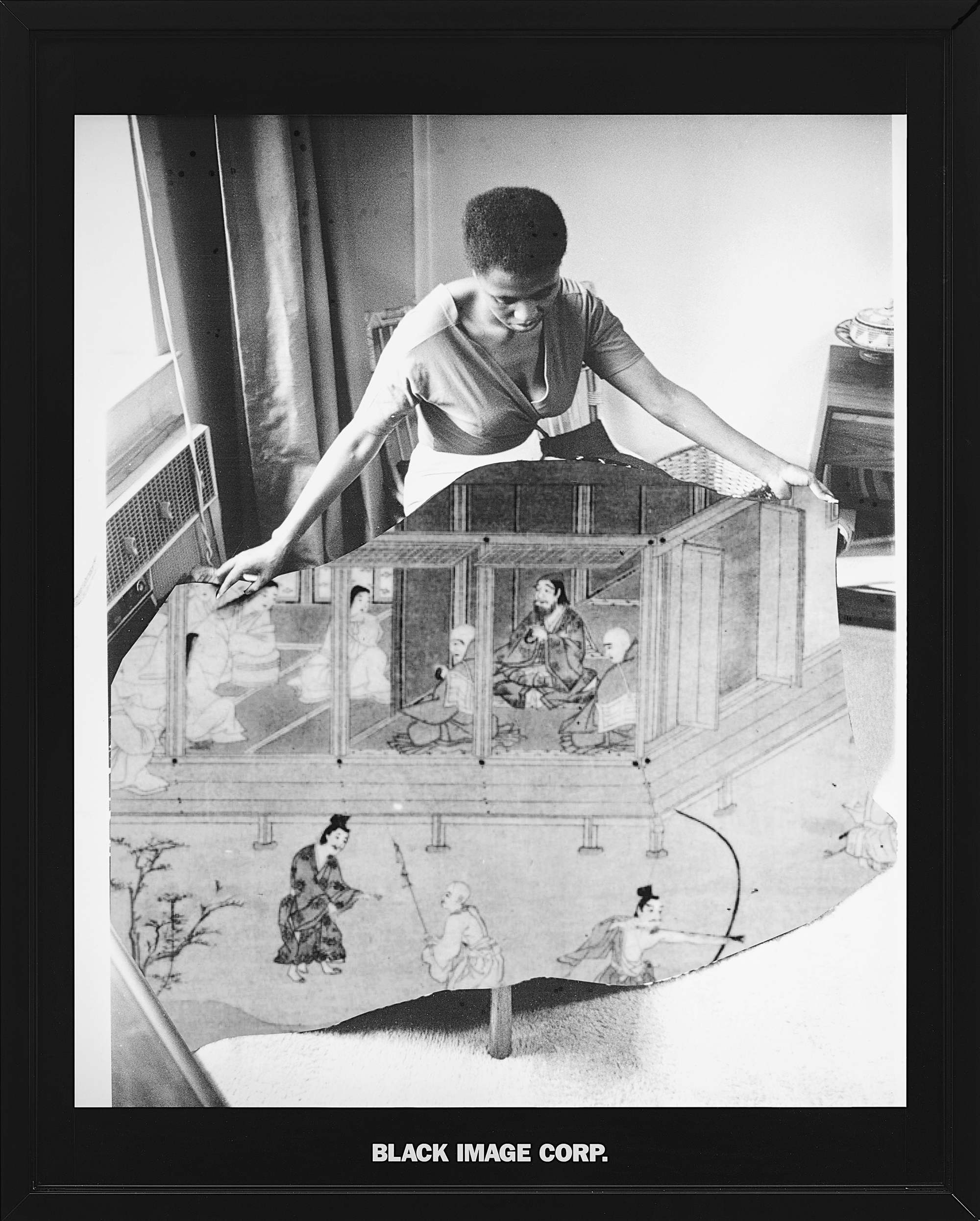
Still from Theaster Gates’s Art Histories, 2019, featuring deaccessioned glass slides from the art history department of the University of Chicago
Eshun: With those ideas in mind, you’ve developed your concept of Afro-Mingei, which has three elements to it. There’s the craft of Japan. There’s the artistic traditions of African America, Black America. There’s also the craft traditions of West Africa coming into play. When we speak of Afro-Mingei as a point of view, is that individual to you, or do others also speak of those same constellations?
Gates: If we go back to mingei: A team of Japanese intellectuals coined a term in the early twentieth century that would try to articulate the importance of how we used to be. That intellectual proposal and propaganda that they were perpetuating through essays, circulars, exhibitions feels a lot like the Harlem Renaissance, the Black Is Beautiful movement, or the Kamoinge Workshop, in Harlem, along with the FESTAC project of 1977, the important work that a young Isaac Julien and a slightly older John Akomfrah were engaged in during the ’70s and ’80s, when they were looking at Black British sound, forming audio and visual collectives. Mingei felt aligned because it was working against a white imperialistic overtaking of a regional or national way of thinking.
Afro-Mingei is first the commingling of ideological resistance, even before you get to anything aesthetic. It was, Oh, they don’t want me to wear an Afro? They want me to press my hair? I’m going to grow my Afro, and I’m going to wear the symbolic clothes of my people, even though they don’t even wear that no more. I’m going to learn the dances of my people. I’m going to learn Kiswahili. You know what I’m saying? So you’ve got this ideological alignment around a people’s resistance to an impeding Western canon. Even though you’re already co-opted into the canon, it’s a co-option and resistance. It’s like C. L. R. James: If we’re going to play cricket, we should beat their ass.
Then there’s an investment in craft excellence without a preoccupation with being the best. So it’s: If you’re going to make something, make it good. That’s a value that I’m trying to bring back from the past. Not even from whiteness to Blackness, from Japaneseness to Blackness. It’s from the past. Can we learn to love to do things excellently?
And then, you have what I would call synchronicity, or syncretism. In the same way we think about the evolution of voodoo and the orishas and Ifa, could we think about a syncretism of an aesthetic nature?
Eshun: It’s a really fascinating tension between politics and aesthetics.
Gates: Yes.
Eshun: Often these are imagined as polarities. But actually, what you do holds a certain tension the entire time.
Gates: I’m tired of either/or. That’s not a truth that I was born into in 1973. I was already an amalgam. I was already speaking English. And then, after a couple trips to Tokoname, my Japanese ceramic literacy was more advanced as a language than my American education. So, it’s like, Oh, with my hands, I’m speaking Japanese. Art gives me permission to use the languages, filtered through my body and my set of political and ideological positions, and then the output of that is what it is.

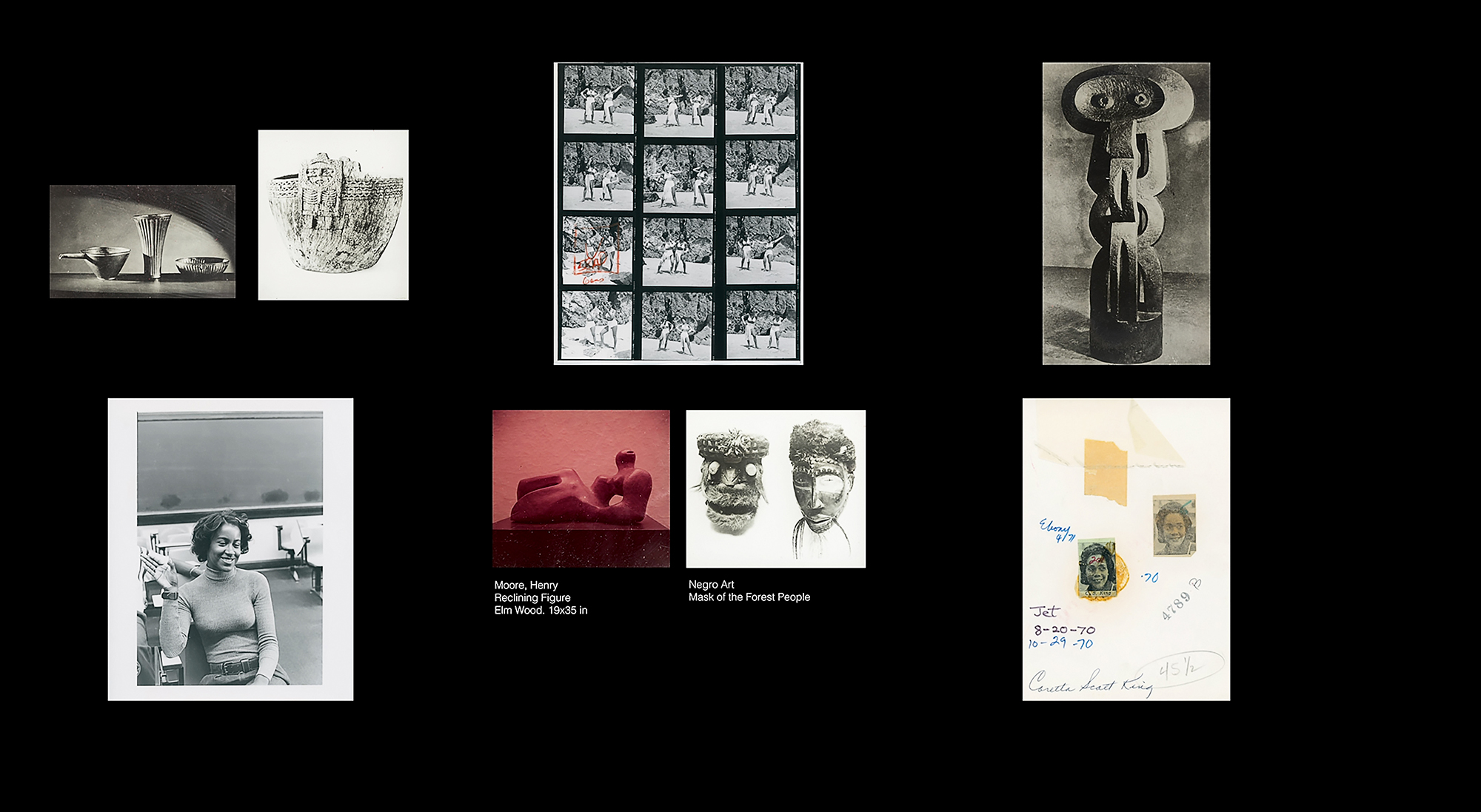
Eshun: I want to talk about When Clouds Roll Away, which took place at the Stony Island Arts Bank, in Chicago. You curated and crafted fifteen thousand objects from the Johnson Publishing Company archive—objects such as office furniture and gym equipment that would historically not have been treasured, alongside photographs from Ebony and Jet magazines, which the company published from their office in Chicago. Can you talk through your thinking in terms of crafting the space as a whole set of ideas?
Gates: Frantz Fanon would say that mimicry happens in the first wave of arrival. So we would want our museums to look like their museums. We would want our houses to look like their houses. So we put some columns up. If they got columns, we got columns. But how do you get to a second and third wave of postcolonial thinking?
For me, what it meant was, could I come to love myself through my things, through our things? Rather than trying to convince the world that I created the most contemporary of contemporary museums, the same way contemporary museums act. So first, the bank was trying to answer that question. Is there a moment where we could shrug off the need to act like other institutions?
With the Johnson Publishing Company, it was the perfect opportunity. Very few people saw value in protecting the office things, and they didn’t see value in the carpet, and they didn’t see value in the maintenance of the legacy of the building of the largest Black-owned public corporation in the world at one point—the kind of largest signifier of the
future of Black dignity, Black aesthetics, Black beauty. I have made it my personal charge, in a somewhat obsessive-compulsive manner, to love those things for myself, and try to create platforms where others might come to love them as well.
Eshun: Where did the title come from?
Gates: The announcement of the bankruptcy of Johnson Publishing created so much smoke. It was, you know, “Look at this dinosaur that wasn’t able to save itself,” and so on. I thought: Okay, when all of those clouds roll away, they’re still one of the most important Black American legacies that will ever exist. And I’m proud of it. I want to put that alongside the over 350 million images sold to Getty, because it’s not just about their photographic archive. It’s about the entire being of that corporation. In 1942 when it was founded, we’re still in Jim Crow. There’s still lynching in the South. And this couple decides that they will take Black imagery and that they would share the progress. Almost like W. E. B. Du Bois. They’re going to share Negro progress with Black people all over the world, so that these Negroes know that they are not alone. That’s the kind of propaganda I’m interested in.
Eshun: The objects become a way both of marking space, but also marking how Black people move through space. Objects. Colors. Fabrics. All of these are markers of how one is comporting oneself.
Gates: When you look at some of the Ebony and Jet images from the 1950s, the sister looks like the photograph of her could have been taken yesterday. You look at the couture fashions that the company bought because they weren’t able to borrow the clothes from the Italian and French houses. When you look at these dresses, they’re timeless. I created a company called the Black Image Corporation. My goal was to try to continue the work that John Johnson, the company’s founder, had started, and the work started by his wife, Eunice, with the Ebony Fashion Fair and these fashion shows that they would send all over the country so that Black women could see themselves.
Eshun: There’s a great line you have in relation to both the Johnson Publishing Company archive, but also to so many other things that you’ve been collecting: “I’ve learned to see the value in gross accumulation.”
Gates: [Laughs.]
Eshun: What’s the thinking?
Gates: We’ve gone to the flea markets, and we’ve marveled at the discoveries we can find. But part of the marveling is that the things that you see at the flea market aren’t from Ikea. They’re from another time. The problem isn’t that history accumulates. The problem is that we don’t always know what the fuck to do with that accumulation. So should there be other things besides the bazaar and the flea market? I would say the museum is one of the other places that holds history for us. I restored a hardware store. In my hardware store, there are objects that hadn’t been touched from the 1960s, when the store opened, and you could see the yellowing of the plastic as an indicator of its age. There’s something in me that believes that my job is to create the form for historical accumulation, and that is as important as the creation of a new work of art for me.


Courtesy Rebuild Foundation
Eshun: You just opened a listening space in the former Currency Exchange Café, in Chicago.
Gates: Yeah, that’s right.
Eshun: It has eight thousand vinyl records from a personal collection, the Dinh Nguyen Collection. Do you look at that space as an homage to craft and recordings? There is a tea parlor as well. What’s the balance between listening to music and sitting, sharing, gathering, even solitariness?
Gates: First, let’s imagine that this project is a demonstration of a platform for the discovery of historical accumulation. We could call it a café. We could call it a listening space. But it’s an attempt at making public someone else’s prized possession. This was this man’s life, his legacy. At the listening space, there’s nothing to buy. There’s nothing to sell. You can order genmaicha, hojicha, or matcha. You can get free teas, and you can listen to the music of this collection. That’s it. People come, and they use their computers. They sit in silence. They come on their first dates. They renew their vows. They scope out the space for a wedding and funeral repast.
I’m trying to help the Black imaginary. We need spaces that are not about selling shit, where we could go and we could heal, and we could be quiet, and we could reflect. We need spaces where we could pay attention to someone else’s accumulated treasures and not be charged an arm and a leg. We need Black museums that don’t have the burden of acting like other people’s museums. They just have the burden of being really themselves.
Eshun: It’s the indivisibility of image, object, craft, music, race, collective memory—all of these things together and not apart.
Gates: When I buy a music collection of over fourteen thousand objects of vinyl, its flirtation is its scale. That’s the first thing. It compels me to then want a second encounter, where I play something from the collection. I play something, and then right next to it, the next something is something utterly different. It goes from Beethoven to Brahms to Bacharach. Wait! How did we get to show tunes from a heavy, dark E-flat minor? That’s seduction for me. I never tire of it. But contemporary art? I don’t always want to make objects all day long, every day. If I’m going to get to my best objects, I need to be engaged with other things. The collections function as a kind of ongoing fuel in refuge. It’s a fuel and a refuge.
Eshun: Blackness seems to me, in your terms, a collective project that moves in solidarity, moves in resistance, moves in memory, moves in consciousness. I don’t even know if that’s a question.
Gates: I understand.
Eshun: It’s an observation about the strategy.
Gates: I think about the Organization of Afro-American Unity, and that being an organization that Malcolm X started after leaving the Nation of Islam. All of these projects were shaped by an individual, and because of that individual’s deep belief in a set of values, they turned into grand projects that others could believe in. My first company that I registered in the state of Illinois was called CLAY. The Center for Linking Artistic Youth. I was twenty-five, and I started a company that didn’t make any money. That wasn’t the goal. The goal was to try to propose something. After the Center for Linking Artistic Youth, I go to Japan, I come back, I create the Yamaguchi Institute. The Yamaguchi Institute is not a legally recognized organization by the state of Illinois. It’s an idea that a Japanese potter goes to the United States, learns of the civil rights movement, marries a Black woman, and they commit their lives in Mississippi to teaching Black kids how to make pots. I basically reversed my story.
Eshun: You create spaces that let people approach art and art-making, old and new objects in ways that reject traditional commercial exchanges.
Gates: I think, in a way, like a farmer. At some point, you just got too many apples. Sometimes, I have a lot of excess, and I need vehicles by which I might share that excess. The collectivism is a way of encouraging form or participating in pre-existing forms, which I also love. So, we practice selling the apples and giving the apples away, preserving the apples to make a jelly, making a compote, and then hopefully, we’re passing on those ways of making apples, preserving them, distributing them. I feel this is in direct connection to the Southern Christian Leadership Conference, the Student Nonviolent Coordinating Committee, and the NAACP. I feel like I’m the child of all of these affirmative action measures, and that those affirmative action measures, no matter what people fucking say, were very important. I really think that contemporary art is in a conundrum because people no longer have purpose or passion. Capitalism has created a new hollow. I don’t want to live like that. So the return to craft is a return to purpose. It’s putting functionality alongside the beauty of abstraction. I want to make a train track, and I want to go off the fucking tracks.
This interview originally appeared in Aperture No. 261, “The Craft Issue.”