




March 12, 2026
Aperture Magazine No. 262 Releases Today: “The End of Nature?”
New York, March 12, 2026—Aperture’s Spring issue brings together photographers who contemplate nature’s fragile beauty and its ever-changing relationship to humanity. From the ancient forests of California to the dwindling coasts of Mexico, from the Japanese island of Teshima to the oases of Tunisia, from India’s sacred Nilgiri forest to the parched landscapes of Iran, “The End of Nature?” offers a sweeping yet intimate look at how nature is entwined with our lives in ways that are both mysterious and profoundly urgent.
The issue takes its title from Bill McKibben’s 1989 manifesto The End of Nature, the first mainstream book about climate change. McKibben argued not that nature was ending, but that its meanings were changing—that climate change had begun to shatter a collective illusion that nature was something separate from our species, and to diminish our false sense of permanency around the natural world. With those concepts in mind, this issue tries to visualize how the world’s deep, ancient rhythms have begun to shift under the weight of a climate we’ve inadvertently shaped.
The poet Dan Beachy-Quick profiles Mitch Epstein, whose majestic photographs of the United States’ imperiled old-growth forests stand as a summation of his decades-long project of documenting the altered American landscape. Eva Díaz explores the unfulfilled promise of the astronaut William Anders’s Earthrise image, a photograph that sparked environmental consciousness even as it remains shrouded in misconceptions. Ian Bourland draws our attention to the dark depths of extractive capitalism, exploring how the history of American photography was forged in the mines.
The issue’s artist portfolios share stories from the front lines of the climate crisis, picturing its stakes with empathy and nuance. In Mexico, César Rodríguez documents life and loss in Mexico’s flooded fishing towns, embracing light leaks and other analog imperfections. Gayatri Ganju embeds with the Indigenous Kurumba people of Tamil Nadu, listening to their stories about the endangered ancestral forest they call home. M’hammed Kilito and Michael Schmelling chronicle bygone utopias within North Africa’s desert oases and California’s radical back-to-the-land communities, respectively. Rinko Kawauchi takes small moments in the Japanese landscape and finds in them a universe, full of rapt attention and stillness, while Lucas Foglia charts the intertwined movements of painted lady butterflies and migrants across Europe, Africa, and the Middle East.
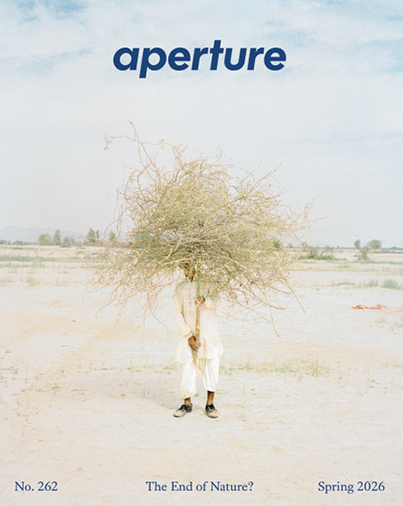
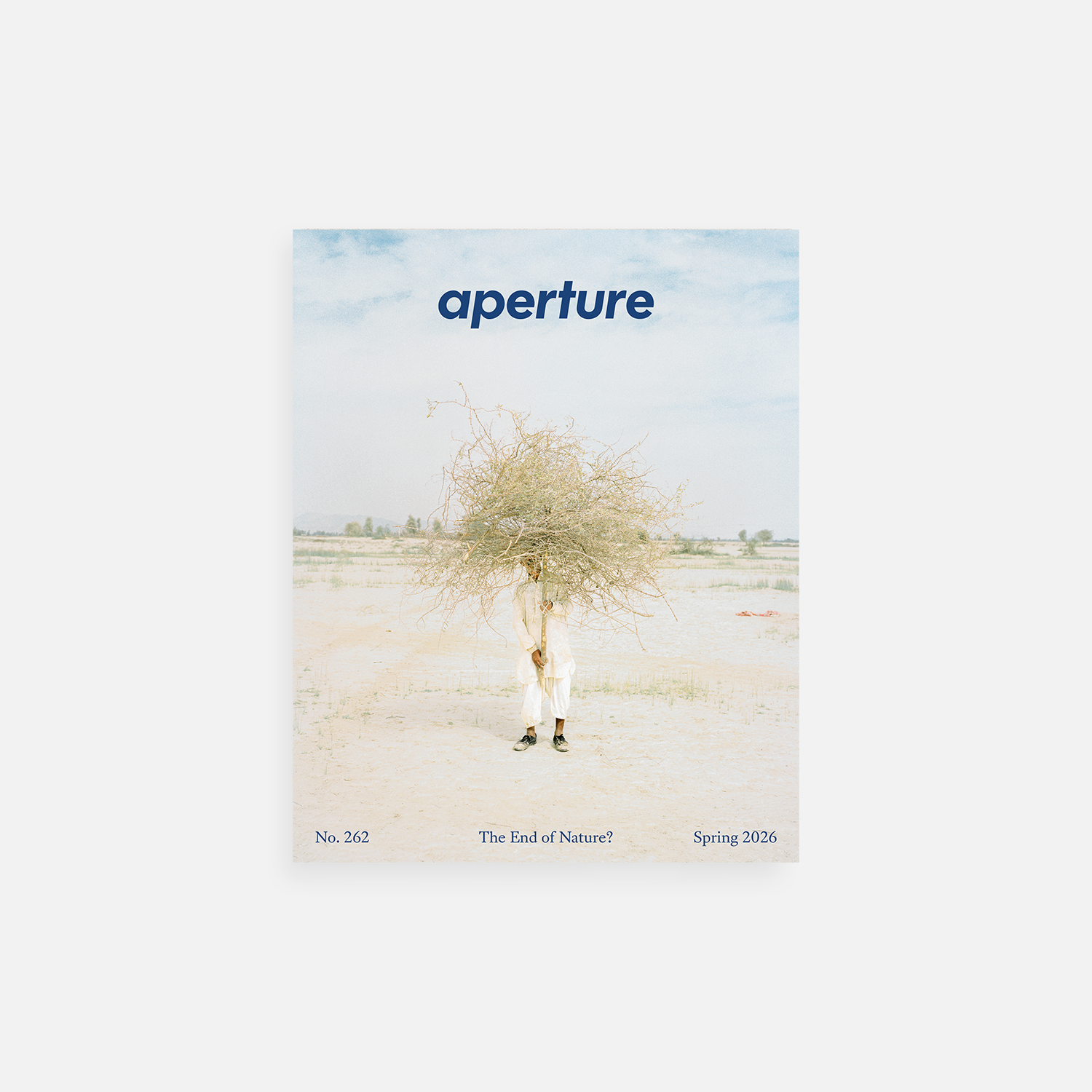
On the cover is an image by Hashem Shakeri, a Tehran-based photographer whose work focuses on environmental degradation and its impact on marginalized communities in Iran. His ongoing series The Kahur Does Not Fall Unless the Earth Wills It portrays everyday life in the drought-stricken wetlands of Balochistan, an impoverished province spanning Pakistan, Afghanistan, and Iran. For Shakeri, the region’s resilient kahur tree is a testament to the beauty that persists in a place of much suffering—a vivid symbol of “the stubborn will to live under the most unforgiving conditions.”
–
Inside the Issue…
Columns & Features
AGENDA
Catherine Opie, Martin Parr, the Black Arts movement, Deborah Turbeville
STUDIO VISIT
Tanisha C. Ford on Louis Mendes’s street style
BACKSTORY
Yxta Maya Murray on Sophie Rivera’s portraits of New Yorkers on the margins
TIMELINE
Shana Lopes on photography and magic
NOTEBOOK
Stephen Shore on a rediscovered work of juvenilia
CURRICULUM
David Benjamin Sherry on Robert Adams, Kenneth Anger, and Lana Del Rey
ENDNOTE
Dana Lixenberg on photographing Tupac, Biggie, and Kate Moss
EDITORS’ NOTE
The End of Nature?
TREE OF LIFE
Can Mitch Epstein save America’s oldest forests?
Dan Beachy-Quick
OASES
Trouble in paradise
M’hammed Kilito
FLOOD ZONE
César Rodríguez chronicles Mexico’s disappearing coastal towns
Elisa Díaz Castelo
DRY SPELLS
Hashem Shakeri tells stories of scarcity and perseverance in Iran
Kaelen Wilson-Goldie
BENEATH THE SURFACE
The underground histories of photography and extraction
Ian Bourland
BACK TO THE LAND
Michael Schmelling tracks a fading counterculture in Northern California
Jeremy Miller
THE PREGNANT TREE
Gayatri Ganju conjures the secret history of a sacred forest
Amitava Kumar
ALIGHT
The everyday miracles of Rinko Kawauchi
Pico Iyer
THE FAR SIDE OF THE EARTH
What was Earthrise?
Eva Díaz
BUTTERFLY EFFECT
Lucas Foglia traces the migration of people and butterflies
Lydia Millet
TERRA INFIRMA
The forensic sublime of Victoria Sambunaris
Sean J Patrick Carney
The PhotoBook Review
TOKYO STORIES
Takashi Homma speaks with Marigold Warnerabout his photobook philosophy
TINY TALES
Hannah Stamler surveys the untold history of children’s photobooks
CLOSE ENCOUNTERS
Silas Martí catches up with São Paulo’s {Lp} Press
MEET THE PRESS
Sue Medlicott and Thomas Bollier discuss the world of photobook printing
Reviews of photobooks by Tessa Boffin, Pippa Garner, Mari Katayama, and more
Support has been provided by members of Aperture’s Magazine Council: Jon Stryker and Slobodan Randjelović, Susan and Thomas Dunn, Kate Cordsen and Denis O’Leary, and Michael W. Sonnenfeldt, MUUS Collection.
About Aperture
Aperture is a nonprofit publisher that leads conversations around photography worldwide. From its base in New York, Aperture connects global audiences and supports artists through its acclaimed quarterly magazine, books, exhibitions, digital platforms, public programs, limited-edition prints, and awards. Established in 1952 to advance “creative thinking, significantly expressed in words and photographs,” Aperture champions photography’s vital role in nurturing curiosity and encouraging a more just, tolerant society.
Press Contact
Lauren Van Natten, publicity@aperture.org