

September 1, 2026
Hiroshi Sugimoto Guest Edits Aperture No. 264 with “Stop Time”
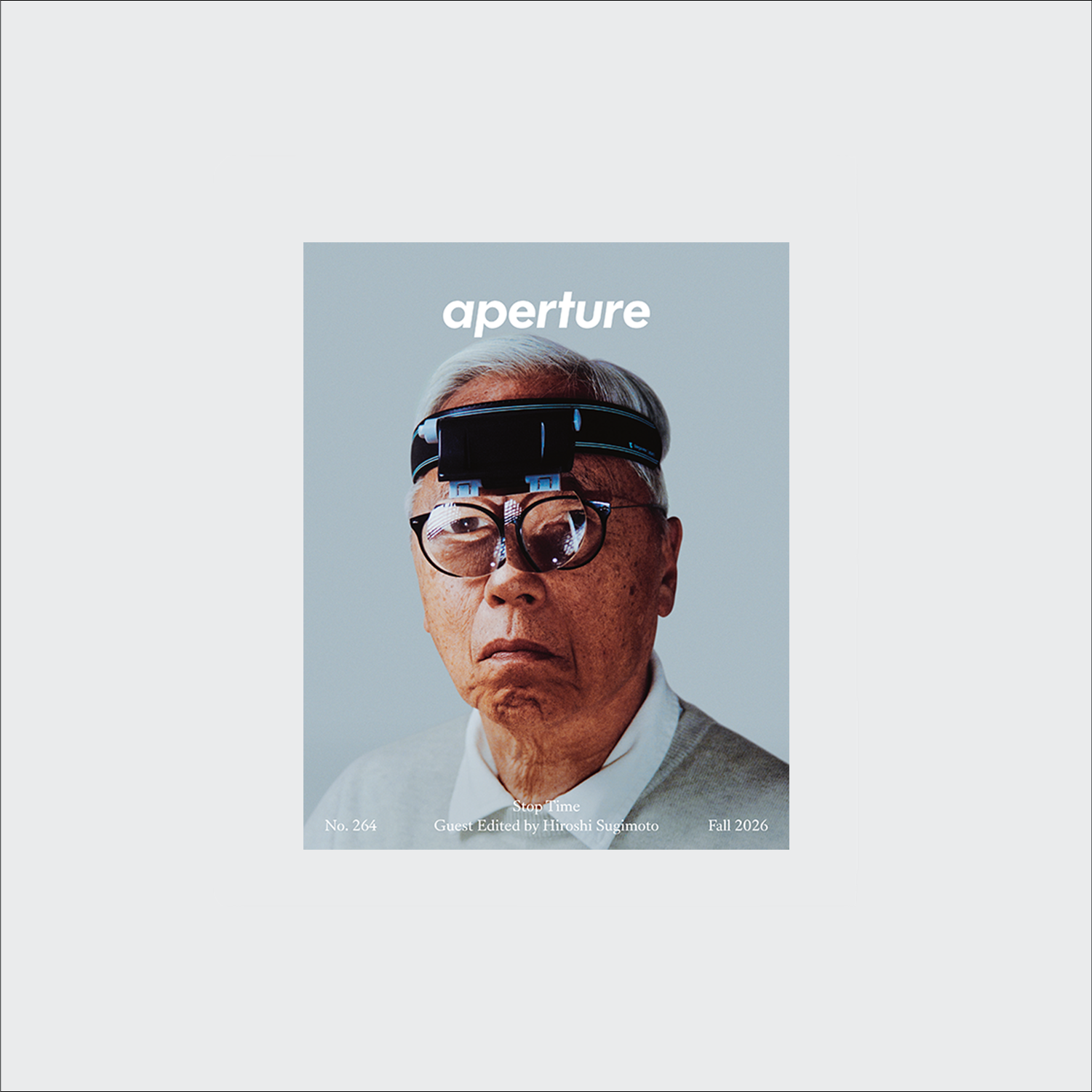
New York, September 1, 2026—This fall, Aperture magazine presents “Stop Time,” an issue guest edited by Hiroshi Sugimoto, one of the most original and influential photographers of the past half century. In Sugimoto’s hands, the magazine has become a kind of time machine, guiding readers through the artist’s wide-ranging obsessions, including the nature of light, the origins of scientific imaging, the threat of human extinction, and photography’s enduring dialogue between impermanence and eternity.
Spanning the years 1637 to 2050, the images featured in “Stop Time” contemplate photography’s unstable histories and its ability to stretch conventional scales of duration. Essays by Lucy Ives, Brian Dillon, Zoë Lescaze, Brad Bolman, and Sugimoto himself explore the surprising history of camera obscuras, Isaac Newton’s discoveries in optics, environmental time capsules, and the origins and endings of photography. The issue also presents Man Ray’s enigmatic Mathematical Objects photographs, a groundbreaking series that first debuted in Cahiers d’Art in 1936.
A conversation between Sugimoto and Michael Famighetti, Aperture’s editor in chief, is accompanied by new photographs by Daniel Shea, who captures the artist’s New York studio—a cabinet of curiosities in its own right—with perhaps the only darkroom in the world to house a 400,000-volt Van de Graaff generator. Shea’s portrait of Sugimoto graces the issue’s cover. Elsewhere, the photographer Stefan Dotter channels the singular atmosphere of Sugimoto’s Enoura Observatory, a Gesamtkunstwerk and aspiring ruin in Odawara, Japan, devoted to meditations on landscape, human perception, and cosmic time.
This November, Sugimoto will join the artist Deana Lawson (guest editor of Aperture No. 256, Fall 2024) as an honoree at Aperture’s annual gala at the American Museum of Natural History, New York, the site where Sugimoto began his landmark Dioramas series fifty years ago. Both artists have pushed photography in bold new directions, demonstrating that the medium’s capacity to expand the world and estrange the familiar remains undiminished.
–
Inside the Issue…
Columns
AGENDA
Sanlé Sory, Hailun Ma, Baltimore photography, and Marianne Wex
REDUX
Iva Dixit on Melissa Auf der Maur’s ’90s rock photographs
BACKSTORY
Sean J Patrick Carney on Jason Fulford’s handheld exhibitions
TIMELINE
Phil Taylor on the history of gag photography
NOTEBOOK
Stephen Shore on how to sharpen your mind’s eye
CURRICULUM
Martine Gutierrez on Dada, The Little Mermaid, and Grace Jones
PORTFOLIO
Christina Catherine Martinez on Carlos Jaramillo’s South Central portraits
ENDNOTE
John Wilson on rare images, the old Times Square, and the history of concrete
Features
THROUGH THE LOOKING GLASS
Hiroshi Sugimoto is playing the long game
Michael Famighetti
SECOND NATURE
The uncanny world of museum dioramas
Zoë Lescaze
SLICE OF LIFE
On photography’s origins and endings
Hiroshi Sugimoto
OBJECT LESSONS
Inside our guest editor’s cabinet of curiosities
HIGHER GROUND
Enoura Observatory is an artist’s refuge for contemplation
Marigold Warner
IN A DARKENED ROOM
The long shadow of the camera obscura
Lucy Ives
MODEL EQUATIONS
Man Ray’s Mathematical Objects
Regina Marler
TIME MACHINES
How photographers invented a new kind of present tense
Brian Dillon
LIGHT YEARS
Newton’s optical experiments unveiled a novel way of seeing the world
Brad Bolman
The PhotoBook Review
IDOL TALK
Petra Collins speaks with Thora Siemsen about fandom and obsession
LIGHTS, CAMERA, PRINT
Danny King considers a new wave of film-related photobooks
SCREEN TIME
Rob Horning reviews a new book on Vilém Flusser
Reviews of photobooks by Jack Davison, Kazuo Kitai, Newsha Tavakolian, and more
–
Support has been provided by members of Aperture’s Magazine Council: Jon Stryker and Slobodan Randjelović, Susan and Thomas Dunn, Kate Cordsen and Denis O’Leary, and Michael W. Sonnenfeldt, MUUS Collection.
–
About Aperture
Aperture is a nonprofit publisher that leads conversations around photography worldwide. From our new home at 380 Columbus Avenue in New York, Aperture connects global audiences and supports artists through our acclaimed quarterly magazine, books, exhibitions, digital platforms, public programs, limited-edition prints, and awards. Established in 1952 to advance “creative thinking, significantly expressed in words and photographs,” Aperture champions photography’s vital role in nurturing curiosity and encouraging a more just, tolerant society.
Press Contact
Lauren Van Natten, publicity@aperture.org