Inside a Minneapolis Newspaper’s Coverage of the ICE Raids
By supporting local photographers and developing ethical guidelines, The Minnesota Star Tribune is setting a visual standard for reporting on ICE.
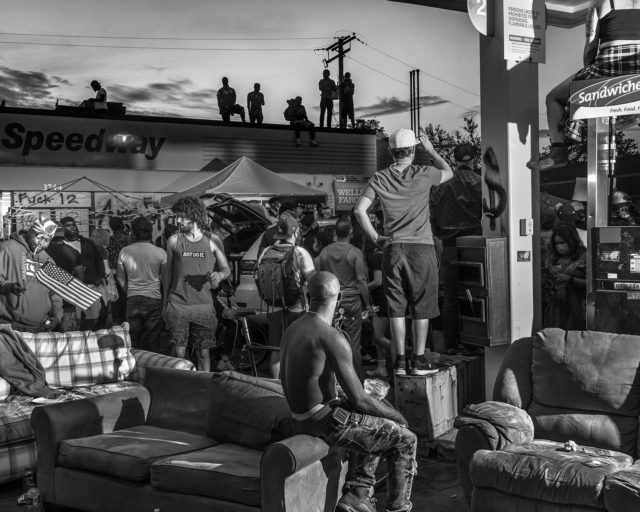
Jeff Wheeler, Protesters clashed with federal agents outside the gates of the Whipple Federal Building at Fort Snelling, January 12, 2026
Courtesy Jeff Wheeler/The Minnesota Star Tribune
Minneapolis had been here before. On May 25, 2020, a teenager named Darnella Frazier recorded the murder of George Floyd outside a convenience store in the city’s Powderhorn neighborhood. Her nearly ten-minute video quickly went viral, shocking the world and galvanizing the largest demonstrations in US history. The following year, in an unusual recognition for a nonprofessional journalist, the Pulitzer Prize Board awarded Frazier a special citation, highlighting her courage and “the crucial role of citizens in journalists’ quest for truth and justice.” Americans are still living in the wake of Floyd’s murder and subsequent, seemingly intractable public policy debates—the call for abolishing police departments; the rise and fall of diversity, equity, and inclusion programs; and the control over the very history of the nation and the people who belong within its borders.
Last December, United States Immigration and Customs Enforcement (ICE) began Operation Metro Surge, a draconian attempt to intimidate, arrest, abduct, and deport undocumented immigrants in Minneapolis and St. Paul. As some three thousand federal agents occupied the Twin Cities, citizen groups organized through Signal chats to follow ICE vehicles, swarming streets and neighborhoods and blowing whistles to warn people in hiding that their lives were at risk. When Renee Macklin Good, a mother of three, was killed by an ICE agent while in her own car during a protest, the story of a city’s fight for its community drew international attention. Veteran photographers like Philip Montgomery and Philip Cheung published dramatic visual reportage for The New York Times Magazine and The New Yorker, respectively, while staff reporters and photographers for The Minnesota Star Tribune filed stories from all corners of the Twin Cities. By the time the Veterans Affairs nurse Alex Pretti was shot and killed by federal immigration agents at a protest on January 24, the combined horror of what was happening in Minnesota—witnessed and broadcast by photojournalists and citizens wielding phones, local reporters and staffers from national media—the consequences of ICE’s actions had sparked near-universal condemnation.
Katie Rausch is the assistant managing editor for photography at the Star Tribune, which employs eleven staff photographers, many of whom have long-standing ties to the Twin Cities. On February 7, the newspaper published “31 Days in Minnesota,” a visual record of a tumultuous period of the city’s history. It’s a period that may ostensibly conclude as ICE draws down their presence, but one that will leave a lasting impact and generational trauma, especially for immigrants and others who had to remain in hiding or alter their daily lives to protect their families. We recently spoke with Rausch about how the Star Tribune covered Operation Metro Surge and the essential role that local photographers play in regional and national media. Our conversation has been edited for length and clarity. —Brendan Embser and Zack Hatfield
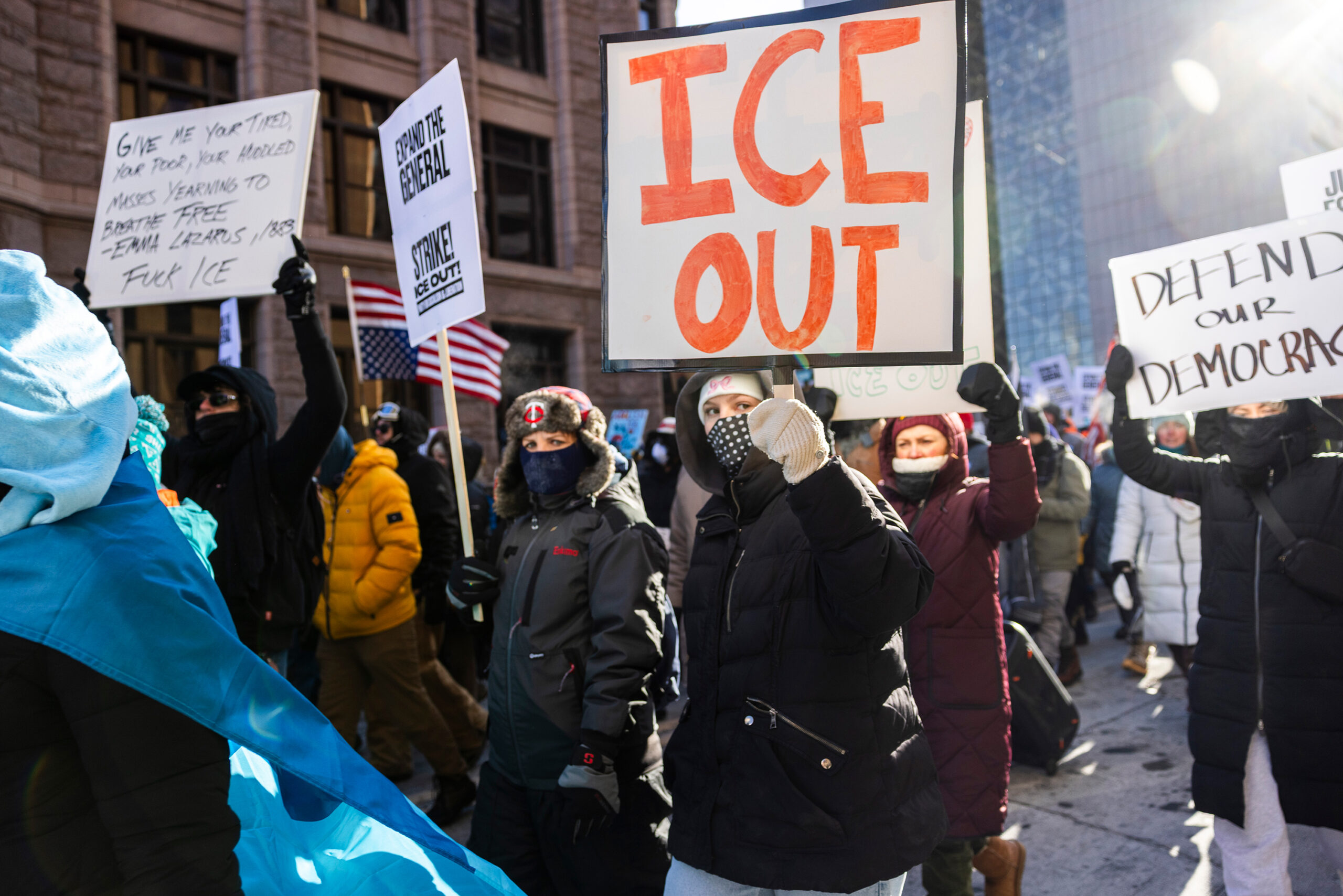
Courtesy Jaida Grey Eagle
We wanted to talk about your role in producing photography for the Star Tribune with regard to what has happened—and what is continuing to happen—over the last several weeks after the deployment of some three thousand federal agents to Minneapolis. How do you approach this kind of coverage, and how do you work with your staff photographers or freelancers when you’re telling a local story that’s becoming a national story?
Katie Rausch: My role as an assistant managing editor here at The Minnesota Star Tribune is overseeing and directing coverage for the photo team and our video team. We have eleven staff photographers and one full-time dedicated videographer, along with three additional photo-editors. Everyone is on this story at the moment, in different ways. We’ve really been in a kind of all-hands-on-deck situation from the get-go.
Because we have such robust numbers on the photo staff, we don’t really use freelancers consistently. And if I’m being completely honest about that, I feel more comfortable working with our staffers on breaking news stories like this, because we can give them the training and the gear that they need. We have our working practices, and we have safety protocols that are pretty robust, and so we’re on the same page. We’ve had some freelancers that have helped us supplement coverage in other places, but our staff has really swarmed to this story for our coverage in the last month.
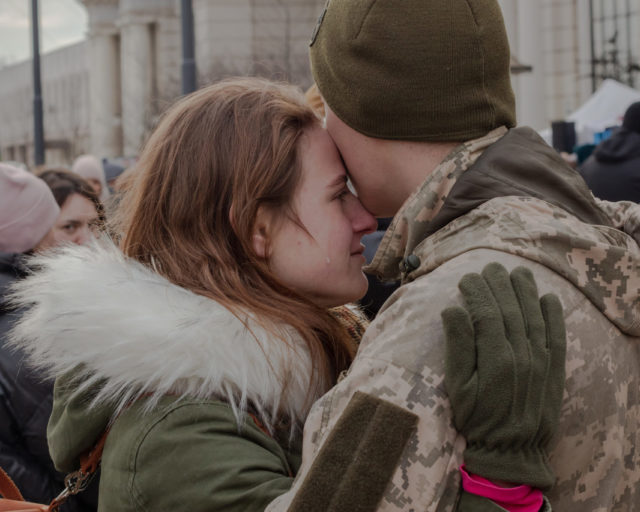
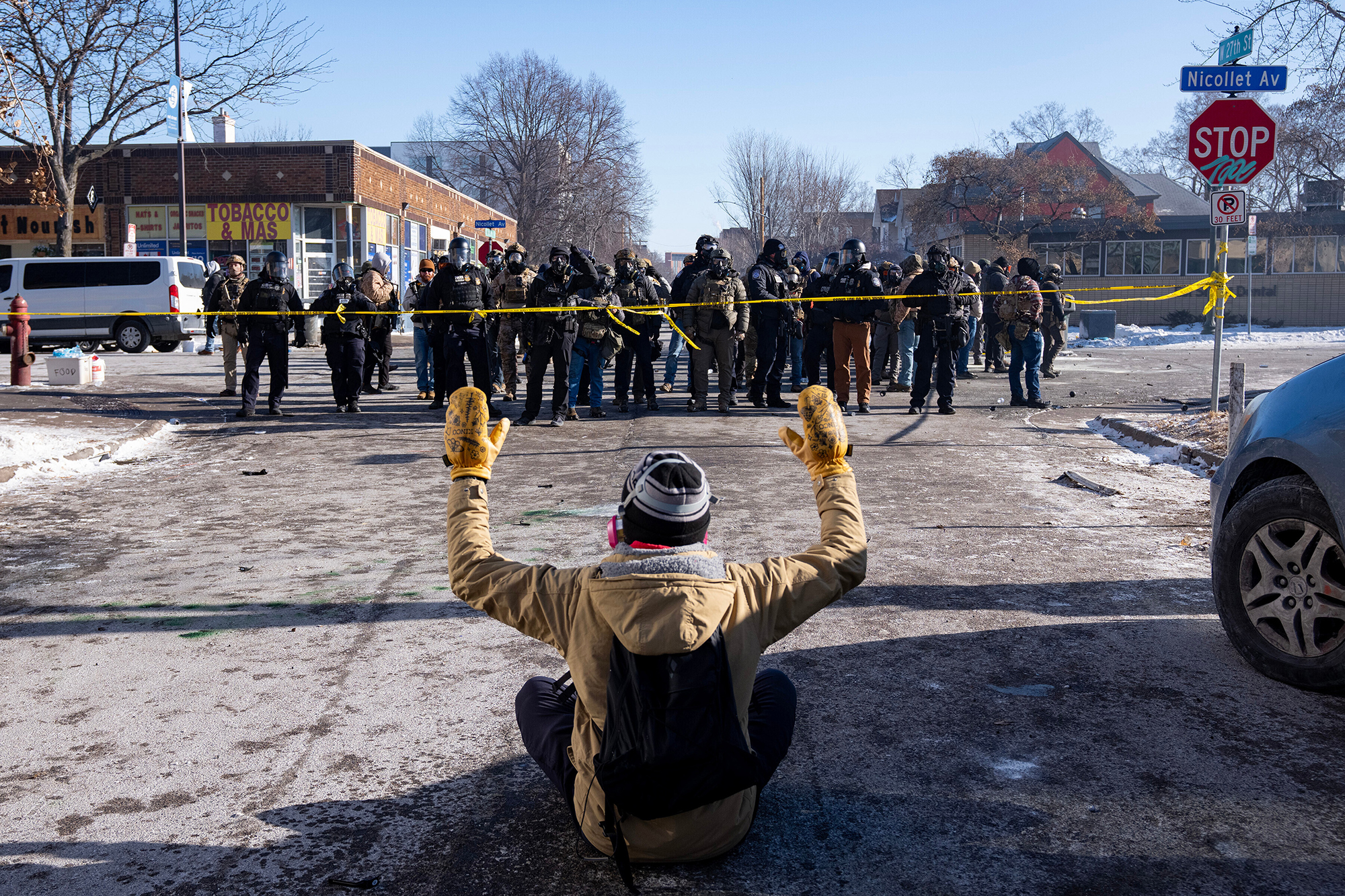
Different staff photojournalists work on different parts of this coverage. Richard Tsong-Taatarii and Alex Kormann, for example, have been covering a lot of the day-to-day actions of federal agents. Some people are covering the community response, things like protests, aid efforts, and vigils. And we have journalists working on stories about the people directly impacted by immigration policy. We want to document this time in our community as fully as we can.
Courtesy Alex Kormann/The Minnesota Star Tribune
What are the internal conversations in the newsroom about the ethical frameworks of covering ICE? Covering ICE as a photographer raises a lot of different questions about protecting the safety of the subject and your staff.
Rausch: Many of our conversations are centered around safety. I’m concerned with everyone’s safety, both our sources and our journalists. I think this kind of coverage does carry some inherent risk for journalists, but our goal is to try to do it in the safest way we possibly can. For us, that meant having domestic hostile environment first-aid training in the middle of all this through the International Media Support Group run by Chris Post. We also invested in a lot of PPE (personal protective equipment), and we have safety protocols so that editors are in consistent contact with photographers in the field. So if we’re in a situation like the day that Alex Pretti was killed or the day that Renee Good was killed, and there are large numbers of people out, protesting in an intense way, and law enforcement might also be responding in a particularly intense way—they might be using chemical agents to disperse the crowd—I’m really concerned about making sure the photographers are able to operate as safely as possible and to mitigate as much risk as they can.
We are a local news organization. We were here before. We’ll be here after.
Aside from the breaking news coverage, we also do a fair amount of work with sources in our community who might not have documentation or are concerned about their status or have just general concerns around their safety if we print things that identify them. We want to make sure that they are all right with the amount of information that we share. We do things like photograph people in a way that is still descriptive but nonidentifying—making sure they’re comfortable telling their story.
The events in Minneapolis have been covered by not only your staff photojournalists and photographers working for national outlets, but also citizens using their phones. How do you evaluate and verify video footage that you may be linking within a story? And how do you handle the recirculation of bystander-captured images that become absorbed into the media ecosystem?
Rausch: Video has been so important to this story. I think the photos and videos that our team is producing are excellent, and I think we are documenting this moment in our community about as thoroughly as we can. But so many of these incidents with law enforcement happen really fast, before we’re able to get there. So we’re working with much more user-generated video than usual.
People on the streets are documenting so much of what’s happening. A huge part of the story is that official accounts from law enforcement are disputed by the videos that we’re seeing. So being able to evaluate and analyze these videos has been important. We have done two analysis pieces where we compared several different angles from video taken during these incidents where Renee Good and Alex Pretti were killed. I think those analysis pieces offer readers a much better understanding of those events.
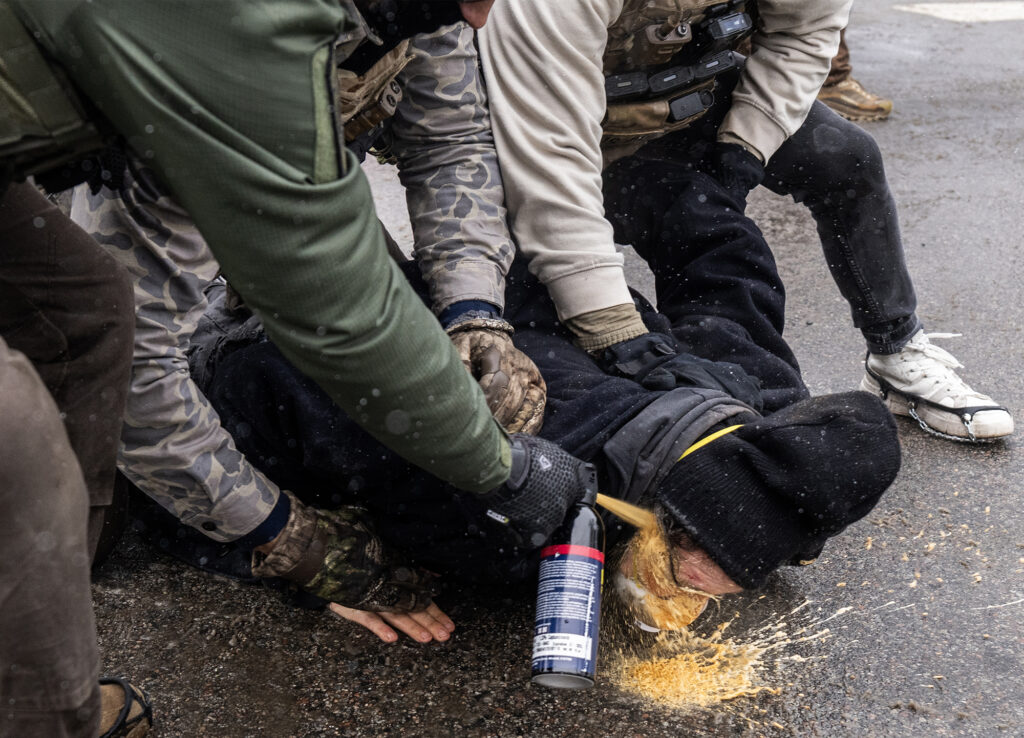
We have had tremendous reader response to all of our journalism, and we want to serve them as best we possibly can and to show them the most honest picture of the reporting. We did a live stream last week with a couple of our reporters and one of our photojournalists who’s been covering this to talk a little bit about what that coverage has looked like for them. That included a conversation around one of the pictures that Richard Tsong-Taatarii took of an agent spraying a chemical substance directly into a protestor’s face as they were held on the ground, and talking about just what was the scene like: How did that picture come into being? How was Rich able to be there for that moment? We want people to understand not just the things that they’re seeing, but how they happened.
Courtesy Richard Tsong-Taatarii/The Minnesota Star Tribune
When a still photograph is taken by a nonprofessional photographer and becomes newsworthy, or even becomes a defining symbol—for example, the image of Liam Conejo Ramos being detained on January 20 in his blue hat and Spider Man backpack—what is the protocol for republication?
Rausch: If somebody were to tweet out a picture, for example, we could embed that tweet into our coverage, and that is not technically republishing that image. If we wanted to take an image and run it in the newspaper, republish it on our website as a stand-alone image devoid of the context of the social media post, we would need to obtain permission from the copyright holder or their representative. In the case of Liam, it was the Columbia Heights School District, with permission from the family, that distributed that picture, so we knew that we had permission to run it. We want to abide by copyright law and protection. So that’s the first stop anytime we’re talking about a reader-submitted photo or a third-party-generated picture.
How do you know where to mobilize your photographers? Signal has become such a huge tool in Minneapolis. Are your photographers on Signal? Are they coordinating with people to find ICE raids through that?
Rausch: One of our photographers, Richard, was in a couple of the Signal chats working with people two months in advance of the surge. He identified himself as a journalist in every situation, and so with their permission, he was following up on a lot of what people were doing. He was checking those scenes out before this was really a national news story in the way that it has become.
Since then, the Signal chats have just exploded. They’re huge. I live in the city, and I was in a couple of neighborhood chats for a few days, and there were just hundreds and hundreds of messages every single day. It’s a lot of information to sift through. There’s an entire protocol—you want to make sure that you are identifying yourself as a journalist and that you’re working appropriately and respectfully and ethically within those spaces. And we do have a couple of people who are still working that way, in part because they’re on assignment to find ICE operations on a day-to-day basis to document them.
Courtesy Jaida Grey Eagle
Do you see a tension between protecting undocumented people in photographs and the demand that ICE agents stop wearing masks? ICE agents are also in many photographs that we’ve seen in the coverage of this story.
Rausch: Well, we abide by the NPPA Code of Ethics for Visual Journalists and the SPJ Code of Ethics, and minimizing harm is really important to us. Members of law enforcement are public servants. They are accountable to the public—they’re working for the taxpayer—and documenting their actions is a big part of our mission. When we’re working with private people, particularly in their homes or businesses, we are always balancing out the potential for harm against the need to inform the public of what’s going on, to make sure that we are documenting this moment in time.
For us, it really isn’t about who should be wearing a mask and who shouldn’t. That’s not really our place to say. Our concern is: How do we weigh the need for the coverage that we’re providing to our readership, to our community, against potential risk to sources who participate in that coverage? We want to make sure that private people who work with us are fully informed and that they’re giving full consent, that they understand what we’re asking and how the photographs might be used, and what that looks like for them. Some people decline to work with us, but we have had many people who want their stories told.
As an editor, how does it feel when other photographers come to Minneapolis to tell this story for national or international news outlets?
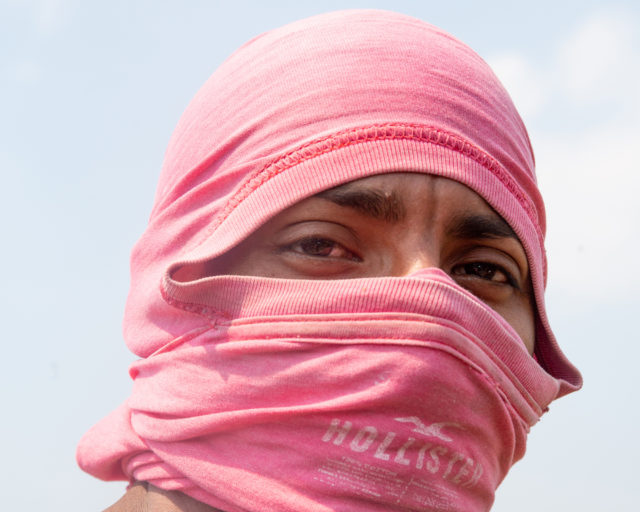
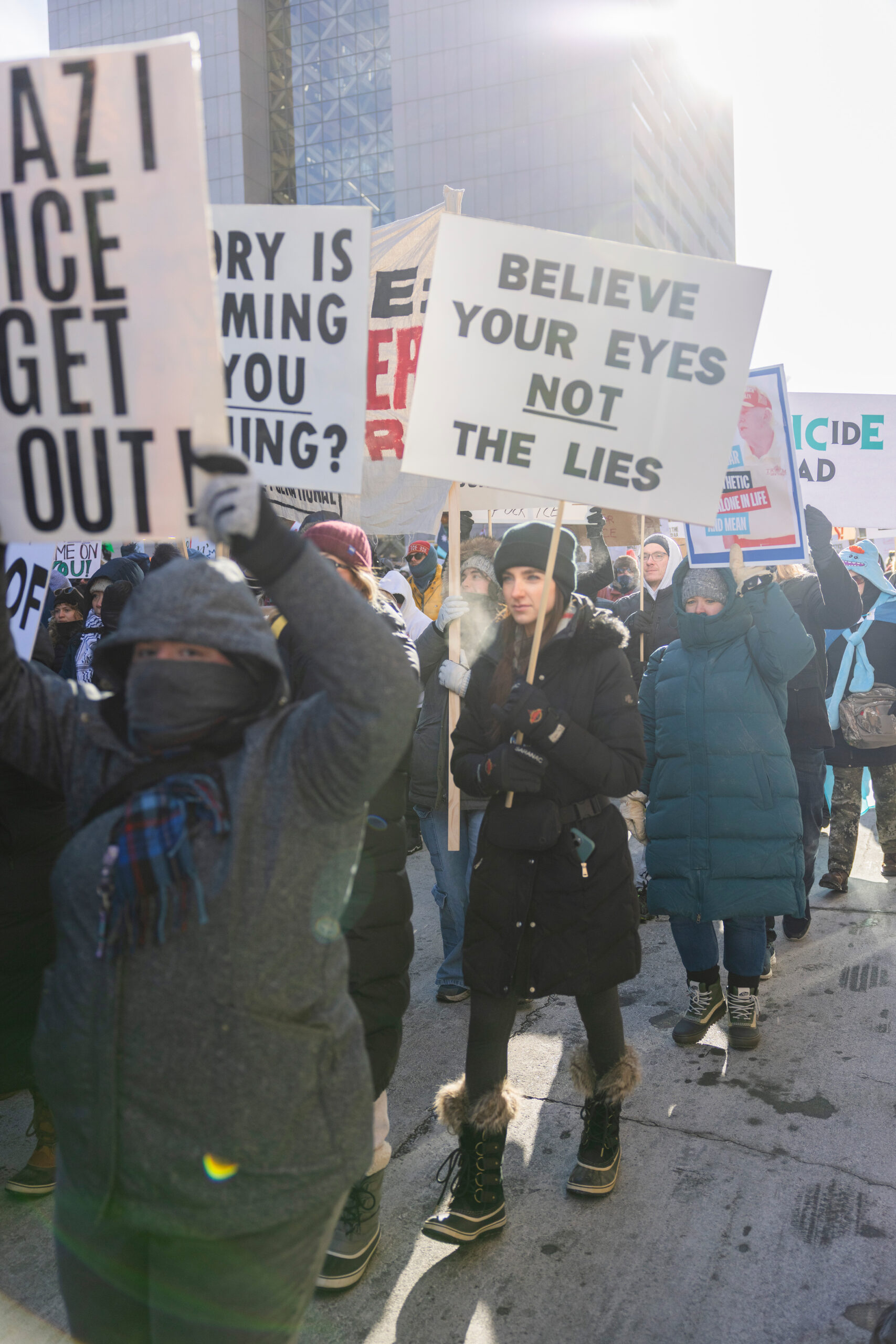
Rausch: There have been so many people doing incredible work. There are local freelancers who our photographers work alongside every day that are doing phenomenal things that I really admire—Tim Evans, Jaida Grey Eagle, Stephen Maturen. David Guttenfelder’s been here and has done really impactful coverage as well for The New York Times. People are in the field supporting each other and working to keep each other safe, and, from my understanding from our photographers, photojournalists have been very collaborative overall.
The Washington Post recently decided to eliminate virtually all of their staff photographer positions. What do you think that signals for the future of in-house photojournalism as more outlets decide to outsource their photo departments to agencies and freelancers?
Rausch: It’s really, really tough to watch colleagues lose their jobs and to see storied institutions be in a position where they have to make cuts that are that deep. For us, having a robust visual journalism team is just crucial for the work we do. I would point to Elizabeth Flores, who has been here since 2006 and taken decades to cultivate sources. She’s telling stories with people whose lives are directly impacted by immigration policy; being a long-term member of this staff allows her to really invest herself in this work. It’s been indispensable in helping our readers understand the situation. We are proud of our staff photographers and proud of the fact that we are able to invest in visual journalism. We are a local news organization. We were here before. We’ll be here after.