© Walker Evans Archive and The Metropolitan Museum of Art and courtesy Art Resource, NY
Essays
Stephen Shore on How to Sharpen Your Mind’s Eye
The photographer considers Walker Evans’s search for truth beneath the surface of the mundane.

Walker Evans was given a major exhibition at the Museum of Modern Art in 1971. That same year, Evans and his friend Leslie George Katz, publisher of Eakins Press, collaborated on an extensive interview. At this retrospective moment of his life, Evans wanted to record his thoughts on photography, his work, and the influences on him. He wanted to codify his legacy. In addition to the interview, Evans selected and commented on eight photographs that spanned the arc of his life’s work. While the interview and the photographs appeared at the time in Art in America, the project didn’t see book form until 1995, when Eakins Press published Walker Evans: Incognito. Charles Baudelaire, one of Evans’s greatest influences, wrote, “The observer is a prince enjoying his incognito wherever he goes.” This suggests that the observer, like a prince traveling in disguise, has a privileged position: They can move through the world anonymously, seeing everything while remaining unseen themselves.
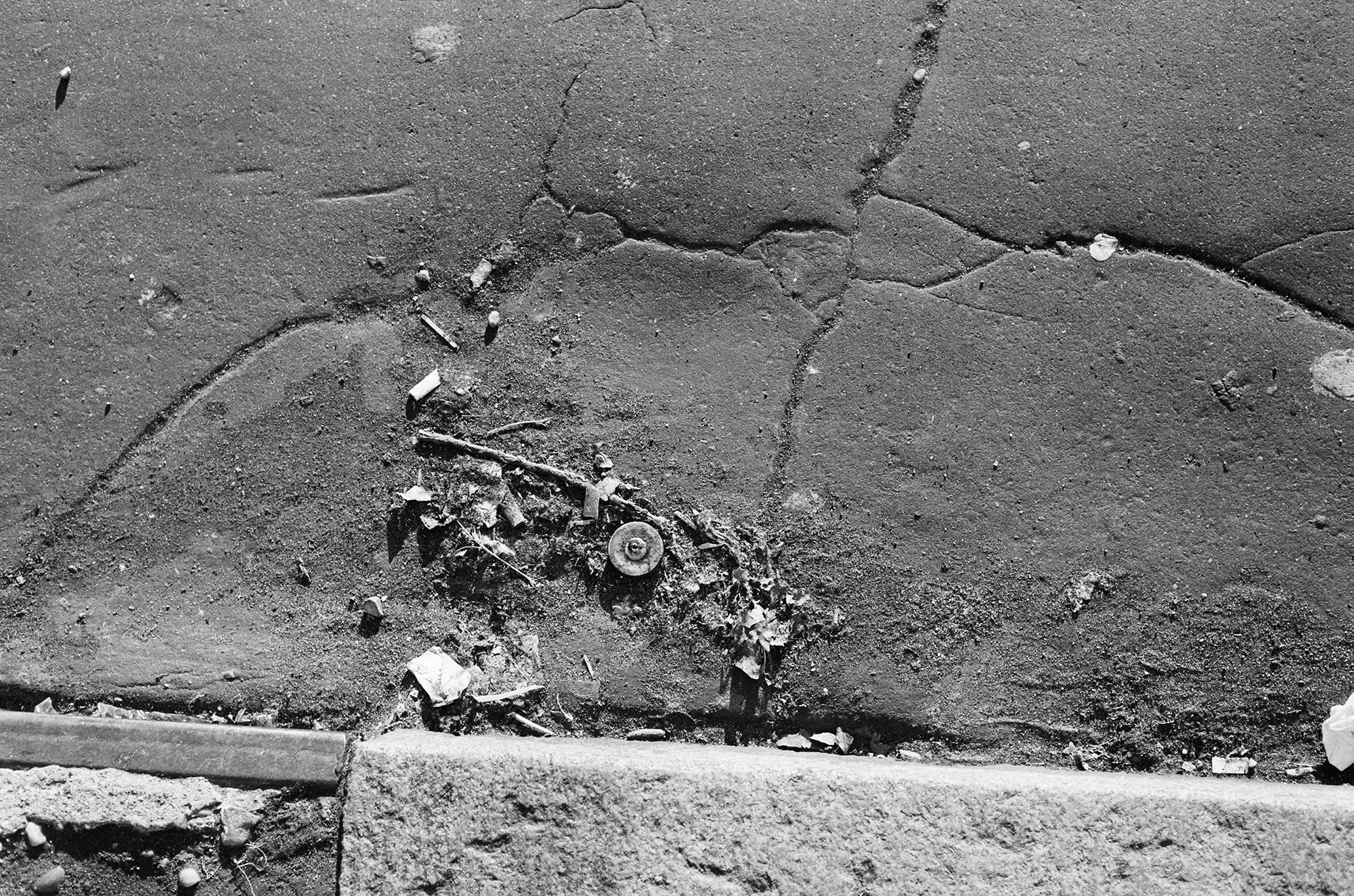
The picture of a gutter was the most recent and least-known photograph in Evans’s selection. It is from 40 Studies of Street Debris, Manhole Covers, and Trash Bins, New York City (ca. 1968). Here is Evans’s accompanying text:
While removed from nature, this picture of a gutter is in a sense very human. It is Baudelairean. I wish Baudelaire was alive to see it. The secret of photography is, the camera takes on the character and the personality of the handler. The mind works on the machine.
When Evans wrote “Baudelairean,” he was referring to this paragraph, describing a chiffonnier, a ragpicker, from Baudelaire’s essay “On Wine and Hashish”:
Here is a man whose task it is to pick up all the rubbish produced on one day in the capital. All that the great city has thrown out, all that it has lost, all that it has disdained, all that it has broken, he catalogues and collects. He consults the archives of debauchery, works through the lumber-room of rubbish. He sorts things out and makes a selection, chooses astutely; like a miser, he collects the muck which, once more digested by the Gods of Commerce, will become objects of utility or pleasure.

Aperture Magazine Subscription
Like the ragpicker, a photographer “catalogues and collects”—a photographer “sorts things out” and “chooses astutely.” Here, Evans looks at a city’s debris, a most common and lowly subject, and in the image he offers a taste of his mind. As Evans elaborated in the interview, “The mind works on the machine—through it, rather.”
Writing now in my late seventies, I know that a time may come when a person reviews their past actions and experiences and recontextualizes them in the light of the perspective of a lifetime. In his interview with Katz, Evans looked back on the experience of his hot streak in the 1930s. He called the experience “a very exciting, heady thing,” adding that “it goes like magic” and “I use the word transcendent.” Evans is describing what I call a gift state. Many artists and writers have the feeling, for a period of time, of something taking over, of something working through them. Evans was now connecting the transcendence of his experience making the work with the transcendence conveyed by the images. They were imprinted with a quality of his mind.
Focus is the nexus that connects the photograph, the world, and the mind. It is the door to the passage from the surface to the interior.
The only time I had the opportunity to hear Evans speak was at a lecture he gave at the Museum of Modern Art in the early 1970s. He showed Corrugated Tin Façade (1936)—a deadpan photograph of a dilapidated contractor’s office in Alabama, sunlight shimmering off the corrugation—and, by my recollection, called it a “transcendent document.” I knew that he had previously described “documentary style” as having the qualities of “severity, rigor, simplicity, clarity . . . without artistic pretension.” I was not expecting him to describe his work as transcendent. He was now indicating that below the surface of a “document” could lie an interior depth. He chose Matisse’s quote “L’exactitude n’est pas la vérité” (Exactitude is not truth) as the epigraph for his book Message from the Interior (1966). He is saying not to mistake the surface exactitude of documentary style for truth, but to look beneath the surface. Truth may be buried in its interior, the message from the interior. Truth can reside beneath the surface of the mundane, the quotidian. This recalls an Arab maxim, “The apparent is the bridge to the real.”
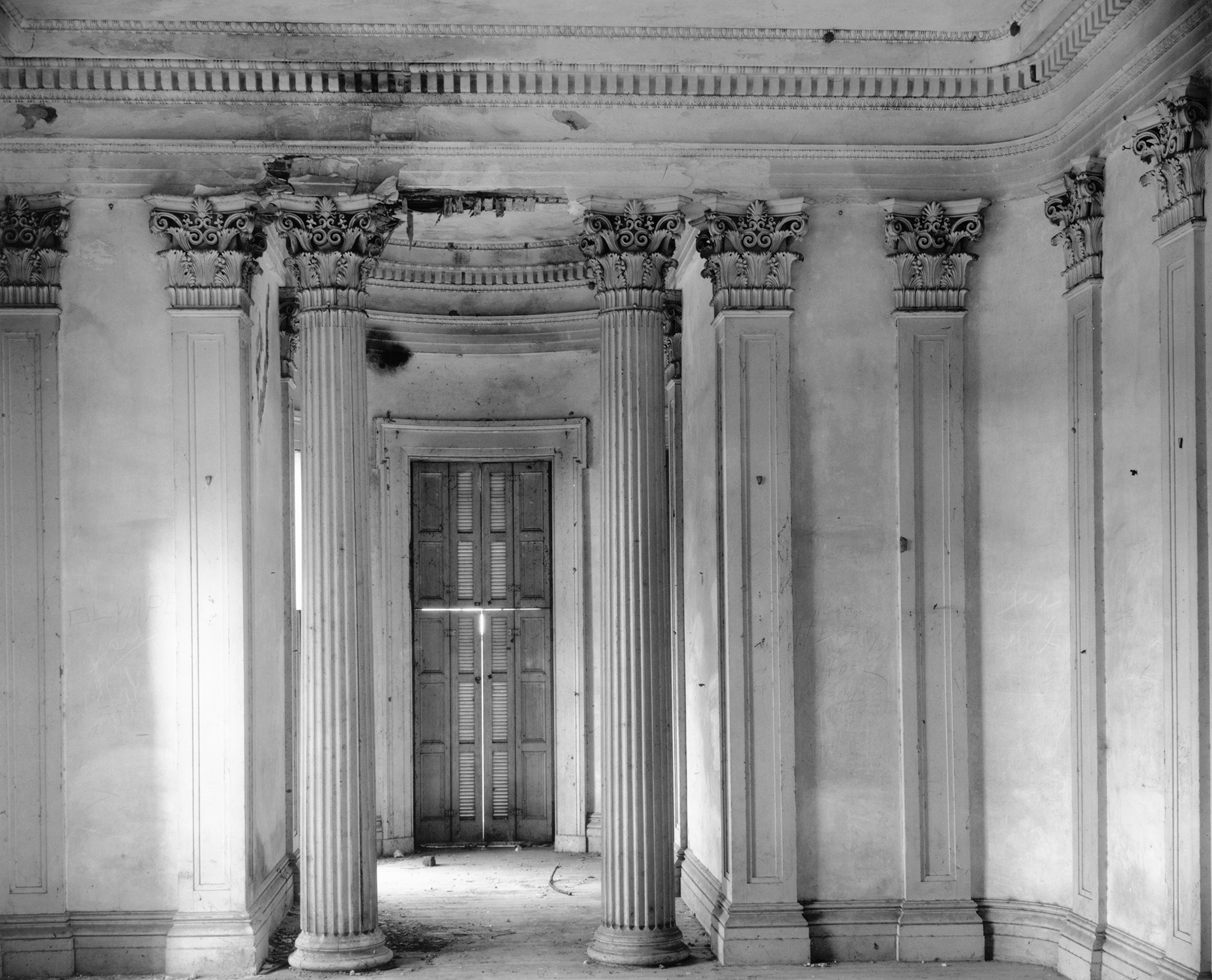
An Evans photograph in which I feel this depth, this undercurrent, an image that moves me most deeply, is Breakfast Room at Belle Grove Plantation, from March 1935. In an early act of urban exploration, Evans, accompanied by his future wife Jane Ninas and her friend Christine Fairchild, broke into the Belle Grove mansion. They shared a picnic breakfast in this space he would later call the “breakfast room.” Before making the photograph, Evans arranged the shutters in the center of the picture, allowing just a crack of light to seep through.
The Belle Grove Plantation in White Castle, Louisiana, was built by the sugar planter John Andrews in 1857. The seventy-five-room Greek Revival mansion was one of the largest residential buildings in the American South during the antebellum period. Belle Grove exemplified the grand architectural ambitions of Louisiana’s sugar aristocracy and stood as a testament to the economic power generated by the brutal system of enslaved labor that perpetuated this culture. Without enslaved labor, the plantation could not be sustained. It changed hands several times after the Civil War and was eventually abandoned. By the early twentieth century, the mansion had fallen into serious disrepair.
© Walker Evans Archive and The Metropolitan Museum of Art and courtesy SCALA/Art Resource, NY
Courtesy Erich Lessing and Art Resource, NY
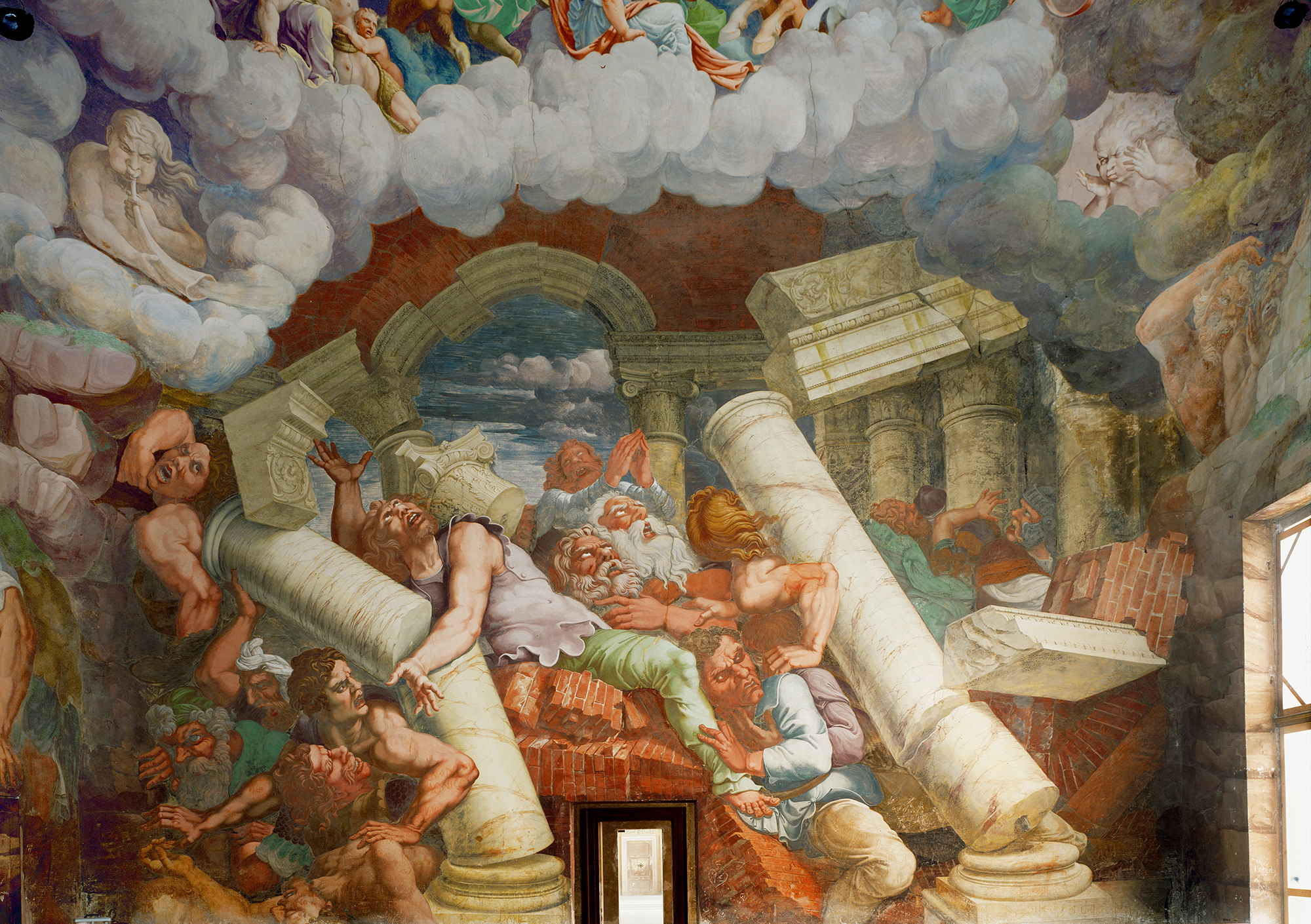
When I see the decaying Corinthian columns in the breakfast room, I think of Giulio Romano’s Sala dei Giganti (Hall of the Giants) in the Palazzo Te. Here the giants are trying in vain to hold up crumbling columns, massive columns tilting and breaking apart, the classical world disintegrating around them, as Zeus and the gods crush the giants for their hubris.
Look at the photograph Breakfast Room at Belle Grove Plantation. Slowly, deliberately, move your attention, your focus, along the side walls to the columns, then to the floor of the small vestibule, and then to the shutters. Notice the depth of space from the columns, across the vestibule, to the shutters. Do you have a sensation of your eyes changing focus? Do you sense Evans’s experience? Do you have a taste of Evans’s mind?
Focus is the nexus that connects the photograph, the world, and the mind. It is the door to the passage from the surface to the interior. It is a way of connecting with the mind that works through the machine.
This article originally appeared in Aperture No. 264, “Stop Time,” guest edited by Hiroshi Sugimoto, under the column Notebook.