Zig Jackson Won’t Let Native America Be Forgotten
The photographer and educator has spent his career asserting Indigenous presence in the American landscape.
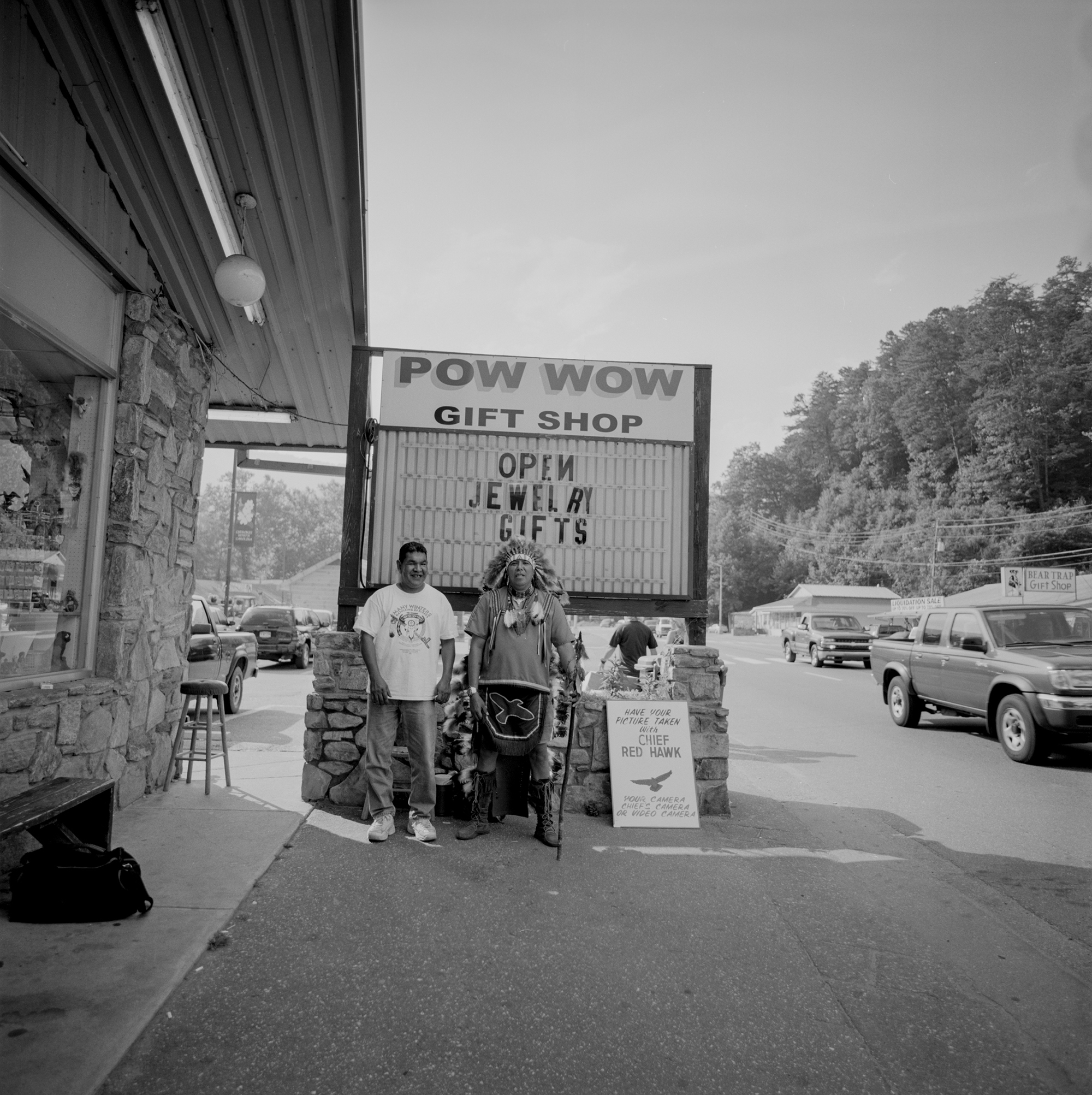
Zig Jackson, Chief Red Hawk/Take a Picture with the Indian, Cherokee, North Carolina, 2004, from the series Degradation
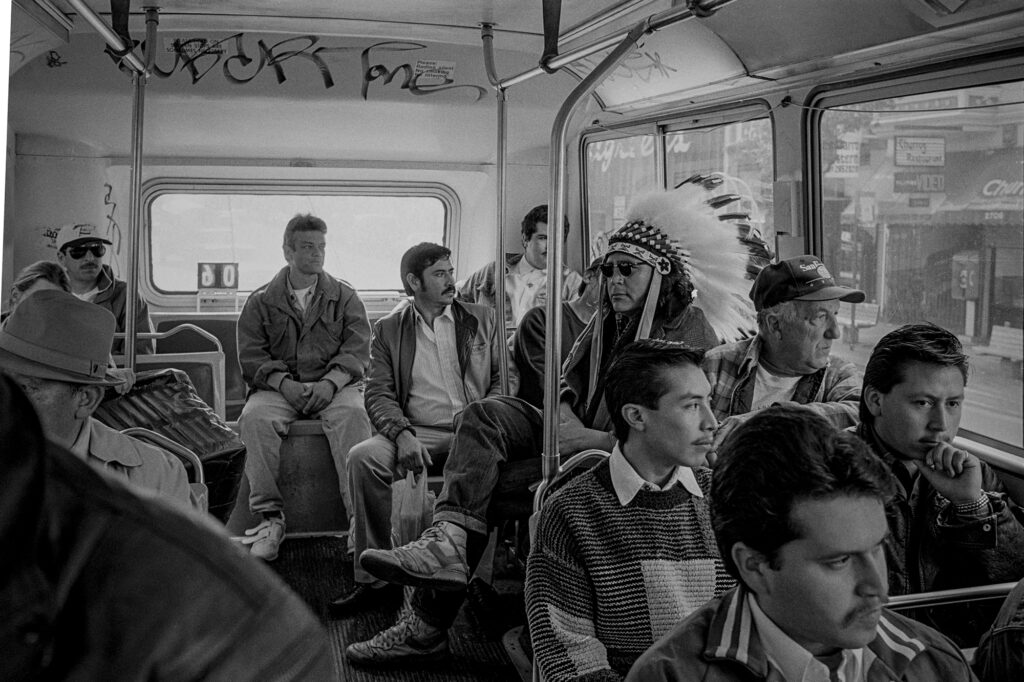
Zig Jackson was a graduate student in San Francisco in the early 1990s when he made Indian Man on the Bus (1994), a brutally humorous black-and-white portrait of a headdressed man traveling by public transit. The man is Jackson himself, the Mandan/Hidatsa/Arikara artist who also goes by his Native name Rising Buffalo. The work was published in Aperture in 1995, a year after its creation, signaling its resonance with the photography audience. Since then, Indian Man on the Bus has become one of Jackson’s best-known works, a fact he finds slightly bewildering given his prolific career and wide range of work.
Born in 1957 at Fort Berthold Indian Reservation in North Dakota, Jackson is a boarding school survivor. He survived two schools: St. Joseph’s Indian School in Chamberlain, South Dakota and Intermountain Indian School in Brigham City. Naming a dozen Tribes whose progeny he met there, Jackson underscores the ways in which Native peoples’ diversity resists erasure and interpellation through racial categorization. His portmanteau “Native American Indian,” which combines “Native American” and “American Indian,” becomes a device for understanding and maintaining self-determination and defying these collapsing designations.
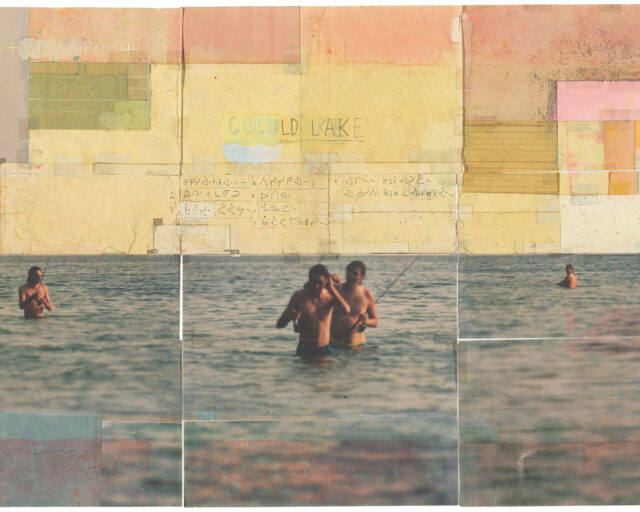
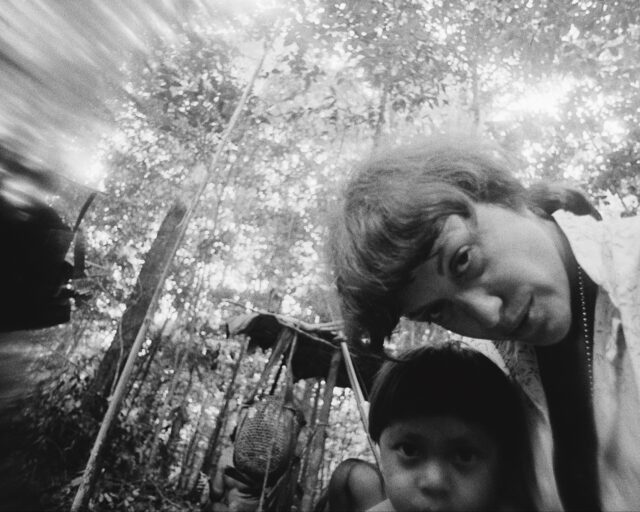
In the early ’80s, Jackson was studying for a master’s in education at the University of New Mexico in Albuquerque. “Then one summer I went up to Alaska, became a commercial fisherman on a Tlingit boat, of all things,” he told me recently. “And I documented that with my camera.” Jackson balances a deep, place-based relationship with the land and nomadism, pursuing kin, culture, and opportunities across North America, always with a camera in hand. He later enrolled in the San Francisco Art Institute’s fine-art photography department, which was founded in 1946 by Ansel Adams, whose final teaching assistant, Pirkle Jones, was Jackson’s teacher. But Adams, infamous among Tribes for landscapes that elided Native presence entirely, received only a terse mention from Jackson when we spoke, which was unsurprising given how completely their practices diverge. Instead, Jackson focuses on amplifying Native people. “I’m here to educate people on the Native American Indian—thank God, we still exist,” he said. In 1994, he became the first Native American to receive a graduate degree in photography from San Francisco Art Institute.
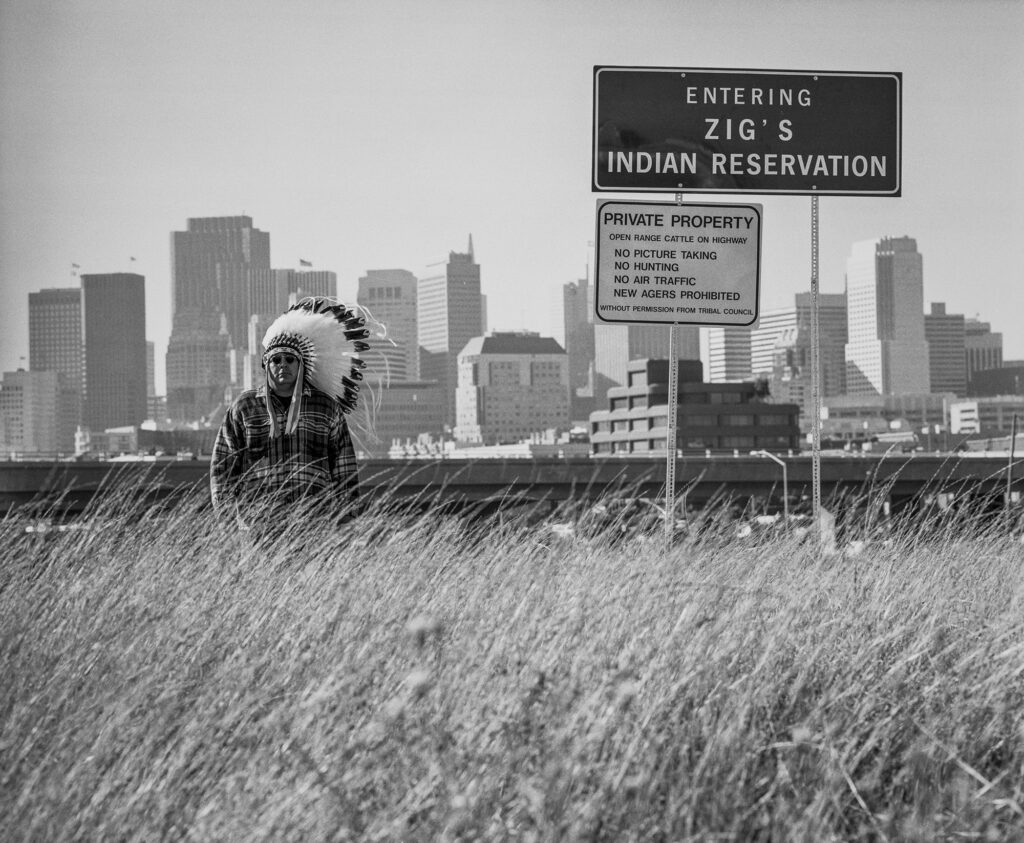
Indian Man in San Francisco, with its signature black-and-white photos, is evergreen. Selections from the series, including Indian Man on the Bus, appeared in an Aperture issue called “Strong Hearts: Native American Visions and Voices” and have been featured in numerous group exhibitions, such as Speaking with Light: Contemporary Indigenous Photography at the Amon Carter Museum of American Art in Fort Worth, Texas, in 2022. But the series’ popularity has at times led to narrow interpretations of his oeuvre.
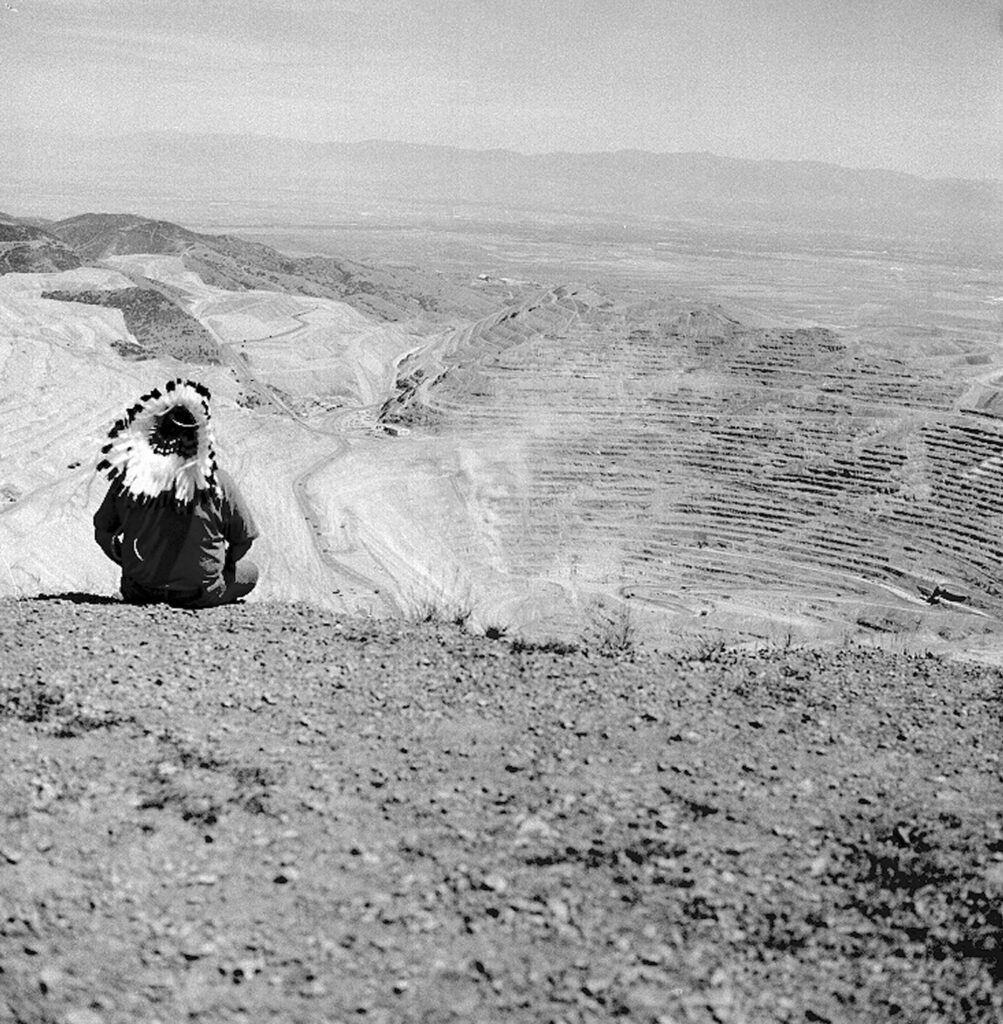
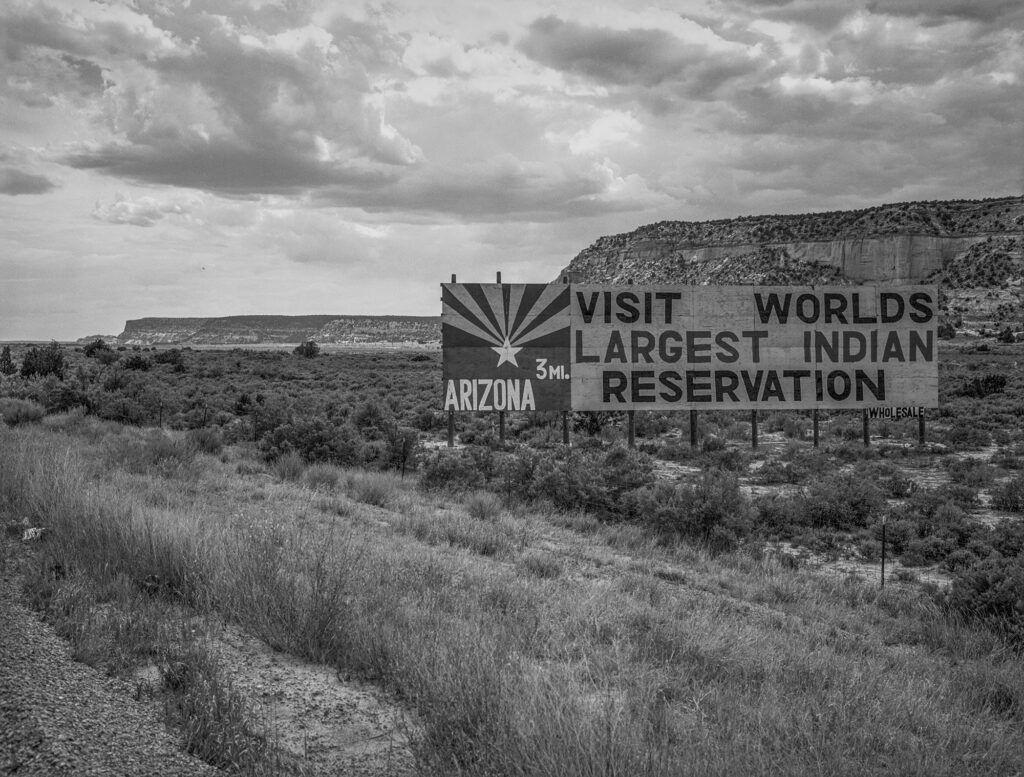
The titles of his other series are efficiently didactic. Degradation (1990–2004) contains a chilling self-portrait called Indian Man at Kennecott Copper Mine (2004) depicting Jackson headdressed and seated facing away from us on the ledge of a deep mining pit at the perimeter of a vast valley. In Visit World’s Largest Indian Reservation (1998), Jackson’s framing of a sign points at the spectacle America makes of its first peoples; genocide continues rendering what are in effect open-border concentration camps a tourist destination, devastatingly visitable by anyone.
When I spoke with Jackson, who is sixty-nine, he was attending the Society of Photographic Education Annual Conference in Atlanta, Georgia. Jackson is an emeritus professor at the Savannah College of Art and Design (SCAD) in Georgia, where he taught from 2000 to 2023. He was avuncular during our talk, and there was an immediate kinship between us formed by shared experience. Weaving together politics and personal history, he detailed the origins of his artistic inspiration. He described fighting with his siblings over commodity boxes, subsidized government surplus food, which they would cover in drawings then discard into a fire. Decades later, in the late ’90s, these boxes would inspire Commodities (Food of My People) (1990s).
But nutritional and cultural starvation is a cruel and unnecessary condition for invention. Following his time at boarding school, he went on to study art at Bacone College, a community college in Oklahoma, before transferring to Northeastern State University to study pottery. On a photo excursion to visit a friend of Sac and Fox descent who had adopted him, he slept on their couch. He noticed a beautiful piece of pottery and asked about its provenance. His friend replied, “It’s yours, Zig. You gave it to Mom years ago.”
Despite Jackson’s humor and hunger for connection, moments of stillness, or even of celebration, return him to the reality of urban isolation. He describes his master’s graduation in 1994 without sentimentality. “When I graduated with my master’s, nobody came to my graduation. I got my diploma and sat on my step,” he said. “Wow. The first Native American in San Francisco to ever get a master’s in photography. And I went down to an Asian restaurant, and I was happy. I sat down, and the guy said, ‘We don’t open till five.’ I said, ‘I just graduated,’ and the Asian guy said, ‘Sit down. We’ll feed you.’ And they fed me.”
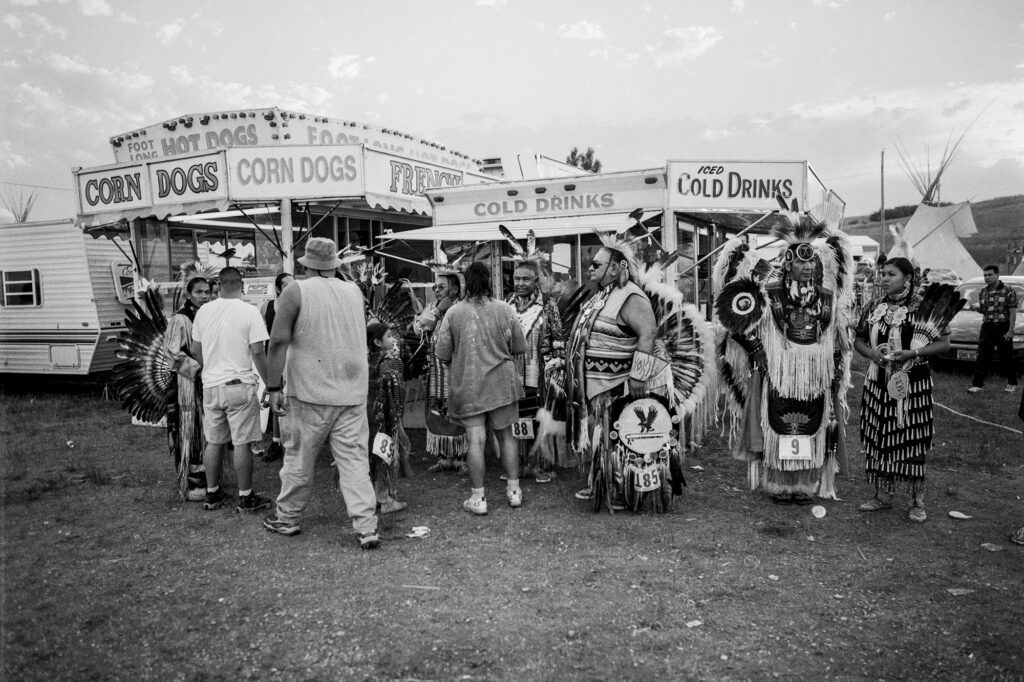
After more than a decade in California, following graduate work at San Francisco Art Institute and a residency at the Headlands Center for the Arts in the early and mid-’90s, Jackson moved on to teach at SCAD. When I asked him about any emerging Native photographers he had noticed at SCAD and across the art world, he said: “Many new ideas and amazing work [are] coming out of these Indigenous [academic] communities—blows my mind.” He highlighted one young Native photographer he admires, Cara Romero, a Chemehuevi photographer who also deploys irony to expose the absurdities of Native life in America, always with poignant levity. “I tell my students, you got to have that humor,” he said. “You got to make fun of yourself. If you don’t have that, your art’s not going to be strong.”
Last year, the George Eastman Museum in Rochester, New York, presented Zig Jackson: The Journey of Rising Buffalo, a solo exhibition that acknowledges and extends beyond Indian Man on the Bus’s performance by showing banal scenes of Native people situated in their homelands and reservations. “He’s showing sometimes the consequences of the reservation system as a whole,” said Eastman Museum curator Louis Chavez. “He’s showing poverty, he’s showing homelessness, but he’s not approaching it from a photojournalistic mode.”
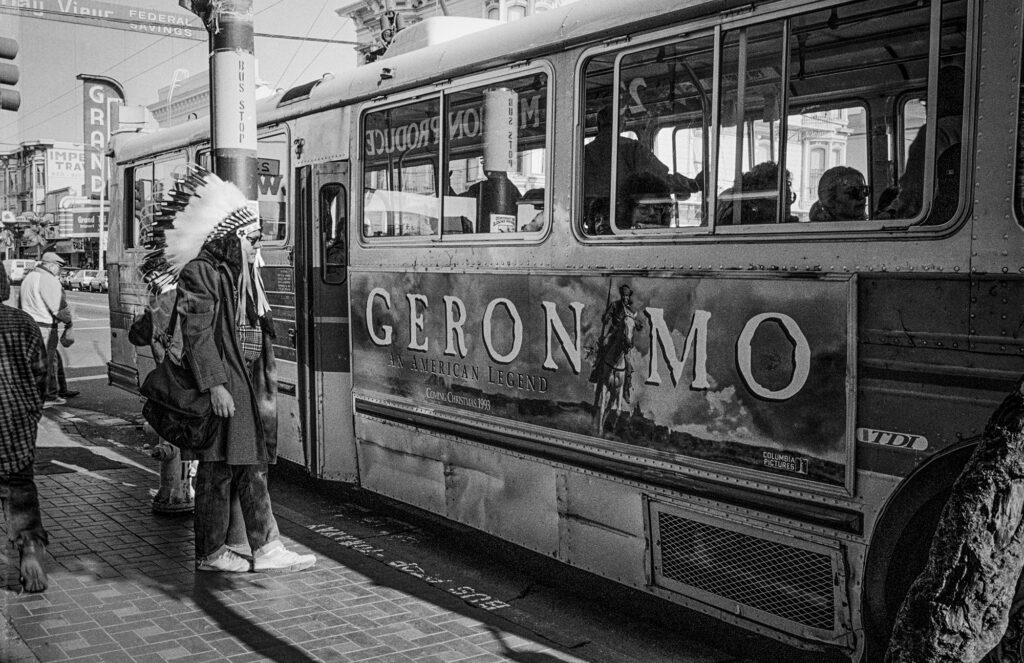
I first encountered Indian Man on the Bus as a Lakota/Dakota child, née working class, from the Bay Area. As my social class changed, the work gained new meaning. But I felt the same sense of isolation and conflict around national and racial identity. How can Jackson and I, both Native Americans, sit beside other Indigenous folks in their own workers’ regalia and assume we understand the contrast at all? They too could be Native American, Ohlone even. If they are Latinx—Mexican, Central American, perhaps Indigenous themselves—how tragic that we are conferred greater legal security when we may have less territorial claim to the seven-by-seven-mile Ohlone Tribal peninsula that only became American 176 years ago. How do borders divide, while race and class bring us together on the bus, where legal status disintegrates and yet ancestral homelands mean everything?
Jackson credits part of his work’s political charge to Native matriarchy and feminist photographers such as Betty Hahn and Meridel Rubenstein, and photography teachers at SFAI like Pirkle Jones, who documented the Black Panther movement in Oakland, California. Soon, he will begin preparing for an exhibition at the University of New Mexico, scheduled for fall 2028. The show would be the achievement of his life’s goal: a retrospective at the school where his photographic practice first took flight.