Essays
The Artist Who Spent Fifty Years Bringing Museum Dioramas Back to Life
Hiroshi Sugimoto has photographed the dioramas at the American Museum of Natural History since 1975. Now his series is coming to a close. Did he find what he was looking for?

A couple walks side by side across a sun-bleached desert. The taller, male figure rests his hand on the shoulders of his female companion, who glances off to one side, lips parted, as though she’s about to remark on some distant curiosity. Seemingly unconcerned by the volcano erupting in the background, they might pass for a pair of flaneurs strolling the streets of Paris—if they weren’t naked and covered in long shaggy hair. Their faces are apelike, with heavy brows, flat noses, and jutting prognathic jaws.
Earliest Human Relatives (1994) by Hiroshi Sugimoto is a bewildering photograph. At first glance, it might seem as though the hirsute figures are models wearing the latest in simian prosthetics, posing for the artist in some remote volcanic region. Or they could be extras from 2001: A Space Odyssey caught sneaking off set for a cigarette break.
But something’s not quite right. The flock of birds pecking the dirt under a nearby tree looks flat and vaguely cartoonish on close inspection. So does the miniscule herd of horses even farther away. There’s something unconvincing about the scene, even as our brains tell us the prehistoric figures are tangibly real.
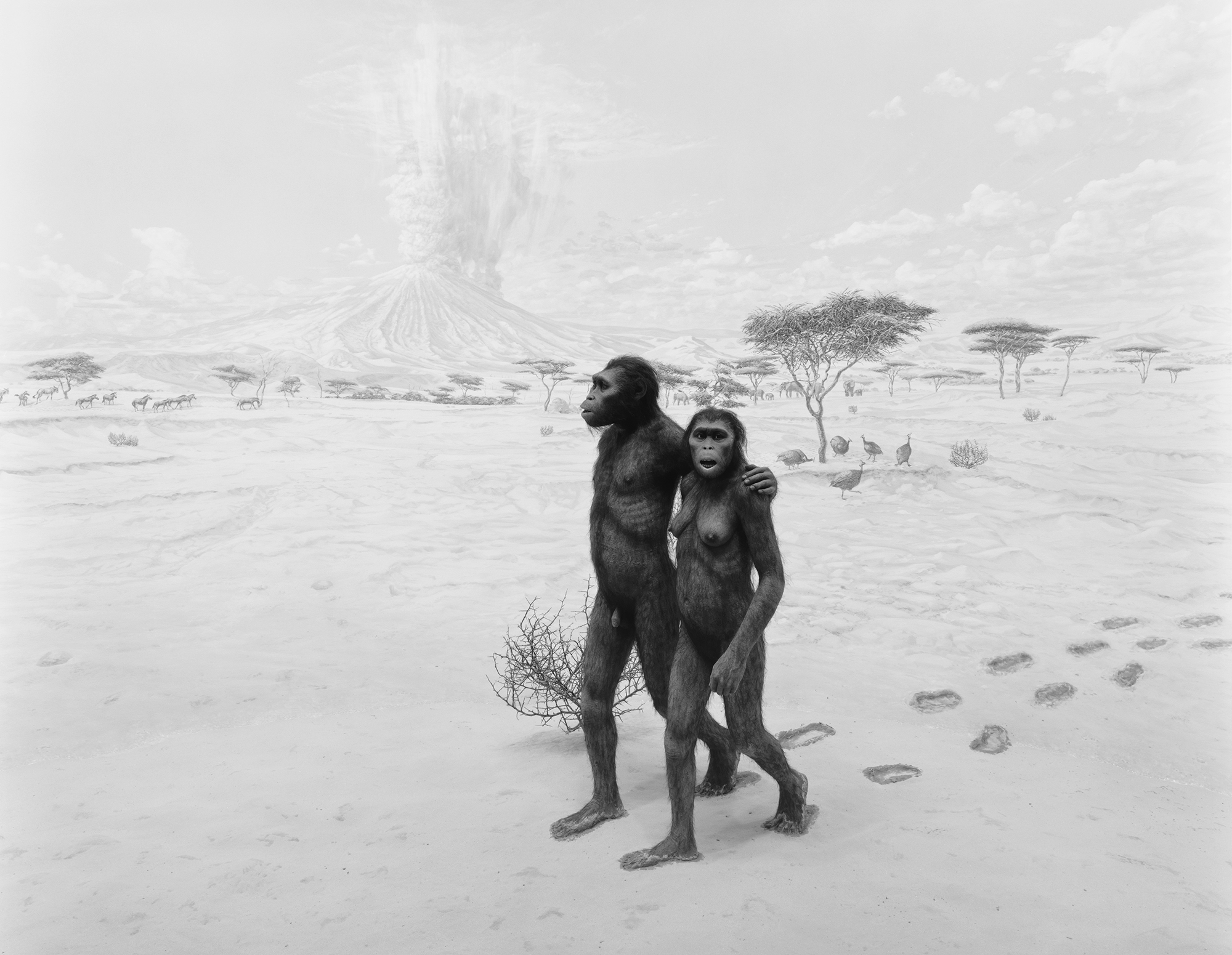
Sugimoto’s enigmatic photograph depicts a bygone diorama at New York’s American Museum of Natural History. The figures—sculptural reconstructions of Lucy, the famous fossil representative of Australopithecus afarensis from Ethiopia, and a male counterpart—once stood on a patch of artificial dirt, before a painted background, behind a large pane of glass. I grew up with this tableau, fascinated by the primordial world (and, yes, the nakedness) it depicted. Transporting though it was, the figures were clearly sculptures, the landscape a mural. In Sugimoto’s deadpan photograph, the diorama appears far more uncanny than it did in life. With his camera, he’s completed the illusion.
When Sugimoto made Earliest Human Relatives, he’d been photographing dioramas for nearly twenty years. The series, the artist’s first and most sustained mature body of work, began soon after he moved to New York, in 1974.
Although it’s tempting to imagine Sugimoto—whose interest in science has since led him to photograph fossils, mathematical models, and the optical effects of prisms—making an immediate beeline for the museum, it wasn’t his first stop. In fact, it was the very last on a list of great institutions he visited to find his bearings in a new city.

Aperture Magazine Subscription
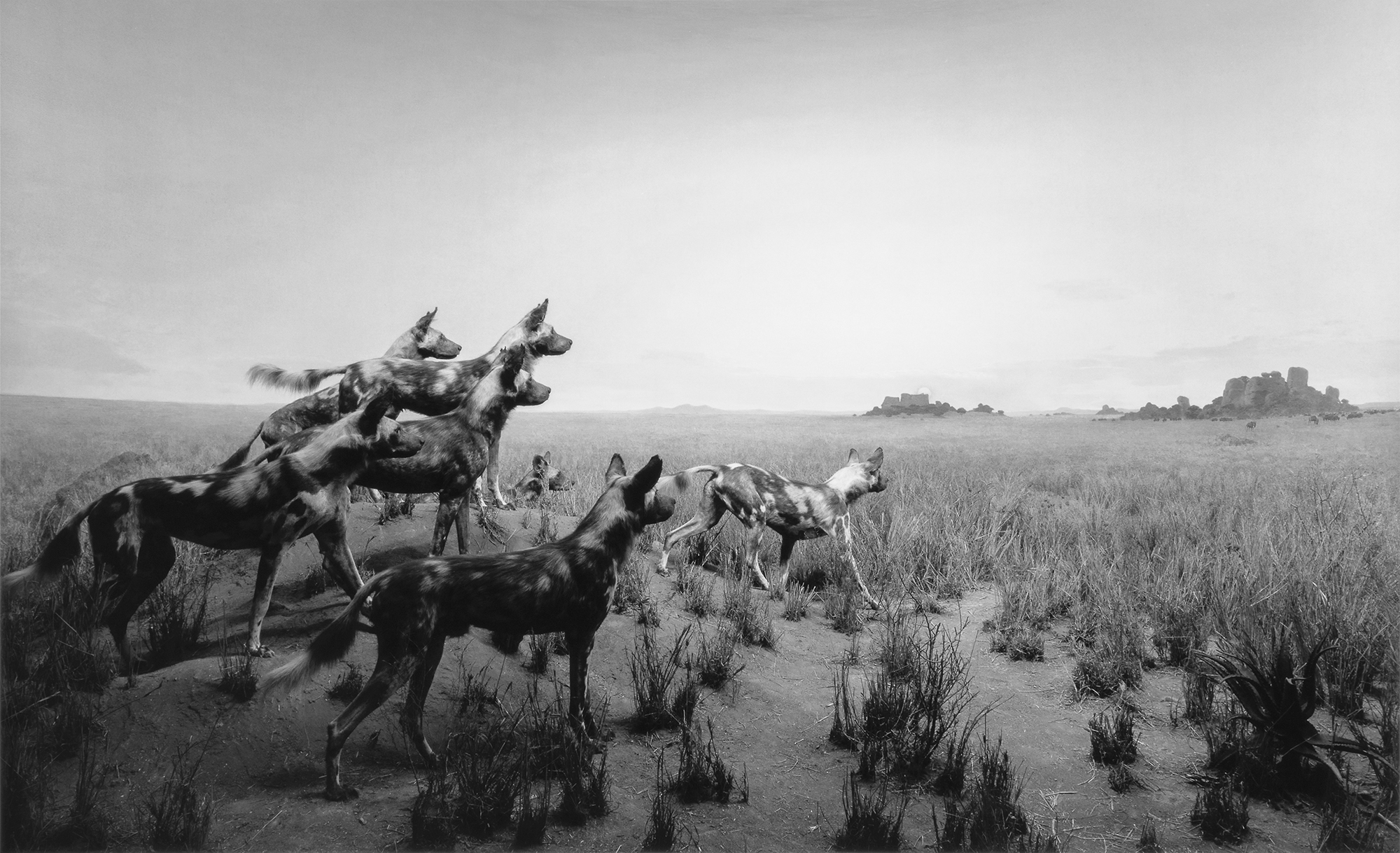
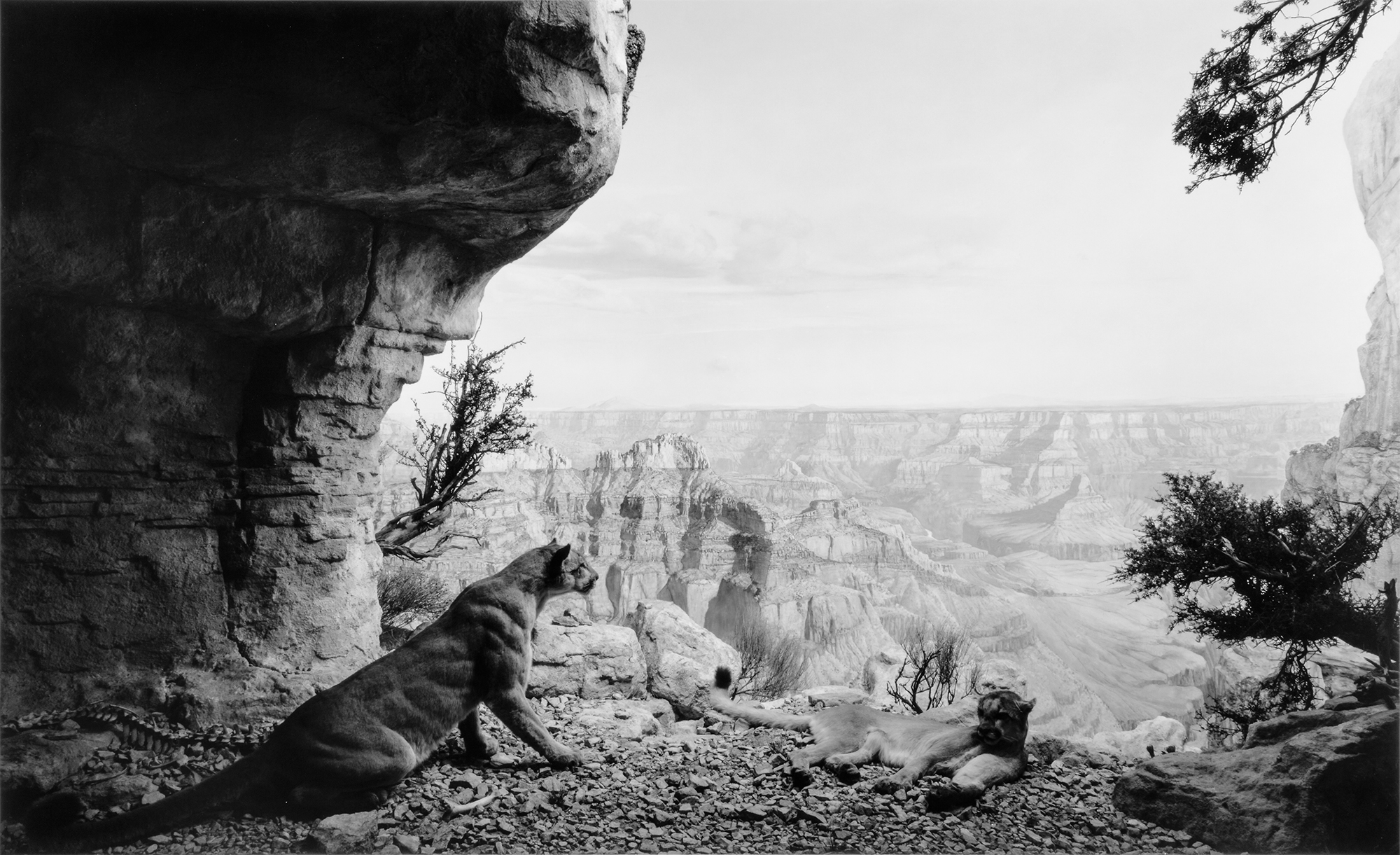
And yet it was there, not in the city’s great art collections, that Sugimoto’s career began. Wandering the darkened halls of wildlife dioramas, he made a startling discovery. These displays, with their taxidermy animals, artificial plants, and painted backgrounds, looked “utterly fake” to the young artist, but when he closed one eye, simulating the way a single-lens camera perceives the world, they suddenly looked real. The seams between the three-dimensional foregrounds and painted walls became undetectable. Instead of static displays inside an urban museum, his photographs seemed to show living creatures in exotic habitats.
In 1975, Sugimoto returned to the museum with an 8-by-10-inch camera. When a security guard asked him if he had permission for the photoshoot, the artist said he did. Technically, this was true. Sugimoto had told museum officials he was a tourist and secured permission to take photographs—he’d neglected to mention he would be constructing makeshift tents around the dioramas to block reflections on the glass or that the exposures would last around twenty minutes.
Sugimoto’s desire to resurrect the lifeless animals on display is the same desire that motivated museum staff to fabricate them in the first place.
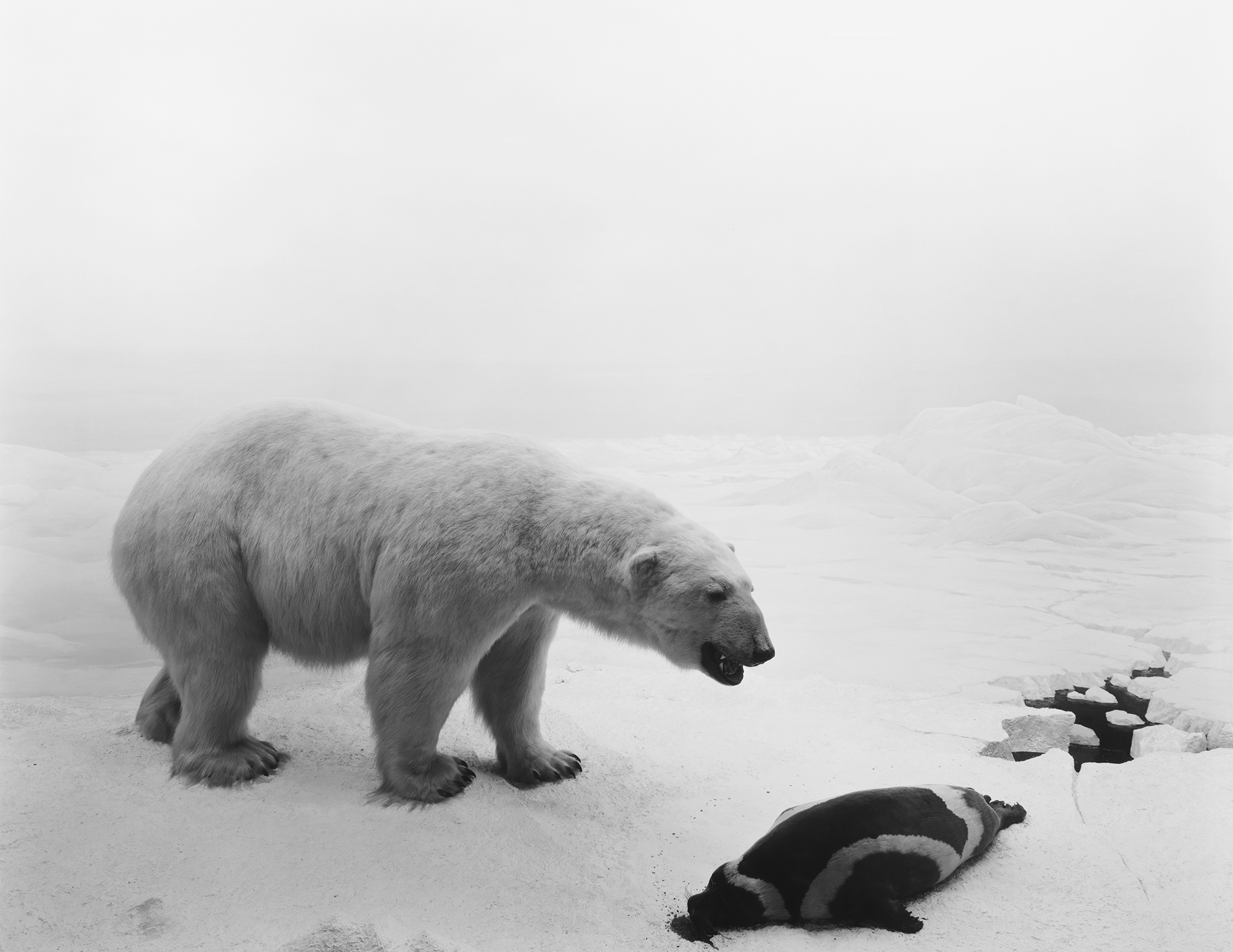
The artist photographed two dioramas on that first expedition. One depicts a rowdy flock of vultures tearing into a zebra carcass. In the other, a polar bear stands over a bloody seal on a stark expanse of ice. “My life as an artist began the moment I saw with my own eyes that I had succeeded in bringing the bear back to life on film,” he later wrote.
Sugimoto’s desire to resurrect the lifeless animals on display is the same desire that motivated museum staff to fabricate them in the first place. The dioramas were the cries of naturalists lamenting the environmental devastation of the early twentieth century.
“As civilization advances in Africa, the extinction of the elephant is being accomplished slowly but quite as surely as that of the American buffalo two generations ago,” wrote Carl Akeley, the pioneering taxidermist, big game hunter, and namesake of the museum’s Akeley Hall of African Mammals. Akeley mourned the destructive impact of Europeans and Americans on the African wilderness even though (or largely because) he’d known the continent when it was a paradise for Great White Hunters.
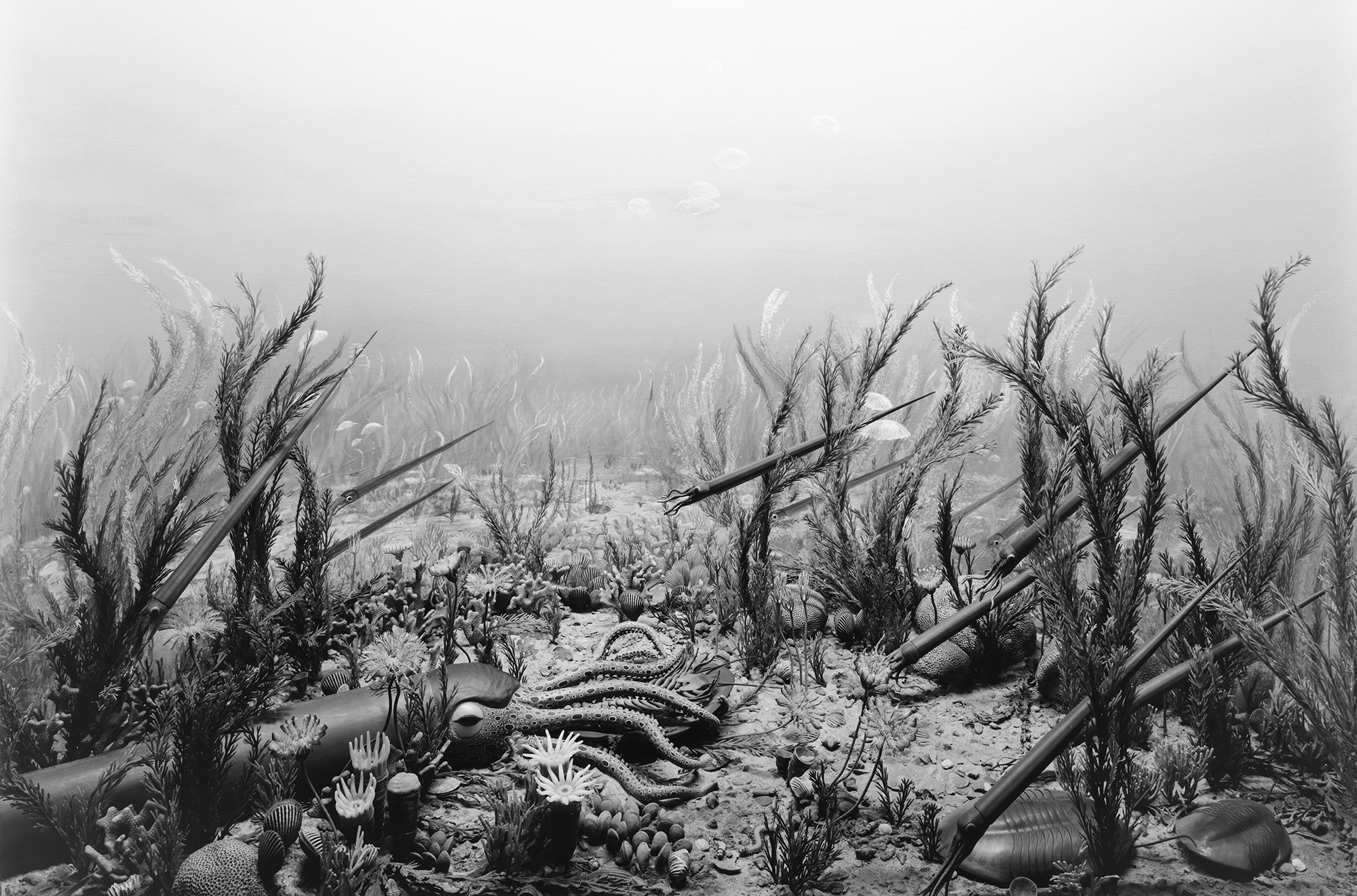
By presenting audiences with spectacular wild scenes, Akeley hoped to rally support for conservation among urbanites who’d likely never experience these places firsthand. Although his preservationist ideals and destructive appetites may be difficult for contemporary readers to reconcile, they weren’t paradoxical for him or the many wealthy sportsmen who championed conservation at the time.
Dioramas themselves have recently become endangered species. Few public museums could afford the costly collecting expeditions and painstaking artistry of the old dioramas today, even if they wanted to. Major institutions have even destroyed their antique dioramas in recent years, replacing them with sleeker, more modern displays equipped with touch screens, animatronics, and other whiz-bang attractions. Although the American Museum of Natural History has largely resisted this trend, Lucy and her companion barely survived a revamp that claimed their volcanic desert environment. Today, the couple stands inside a glass vitrine, surrounded by glowing screens. Over the past fifty years, Sugimoto has inadvertently created an archive of a disappearing art.
Museum staff who once bristled at Sugimoto’s claim that the dioramas look more “real” in his photographs than they do in life have since come around. “He really does, through his work, honor the dioramas as the fine art that they are,” said Stephen Quinn, an authority on dioramas who built and restored them at the museum for nearly forty years. Now, Sugimoto says, the series is almost complete. He took his last photographs at the American Museum of Natural History in the fall of 2025. How did he feel about finishing a body of work he began as a young man? “Relief,” he said, seated in his New York studio. “Fifty years is enough.”
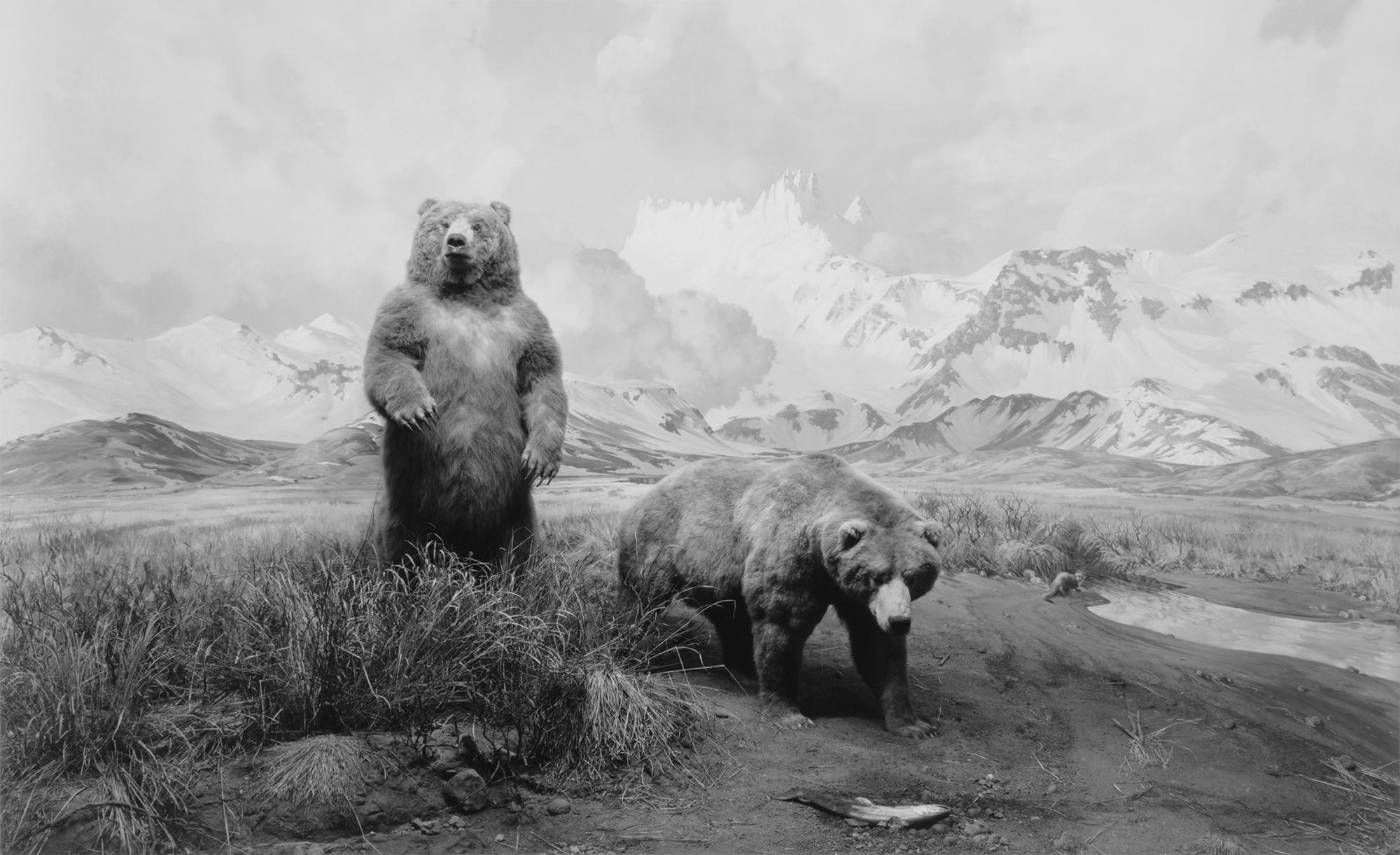
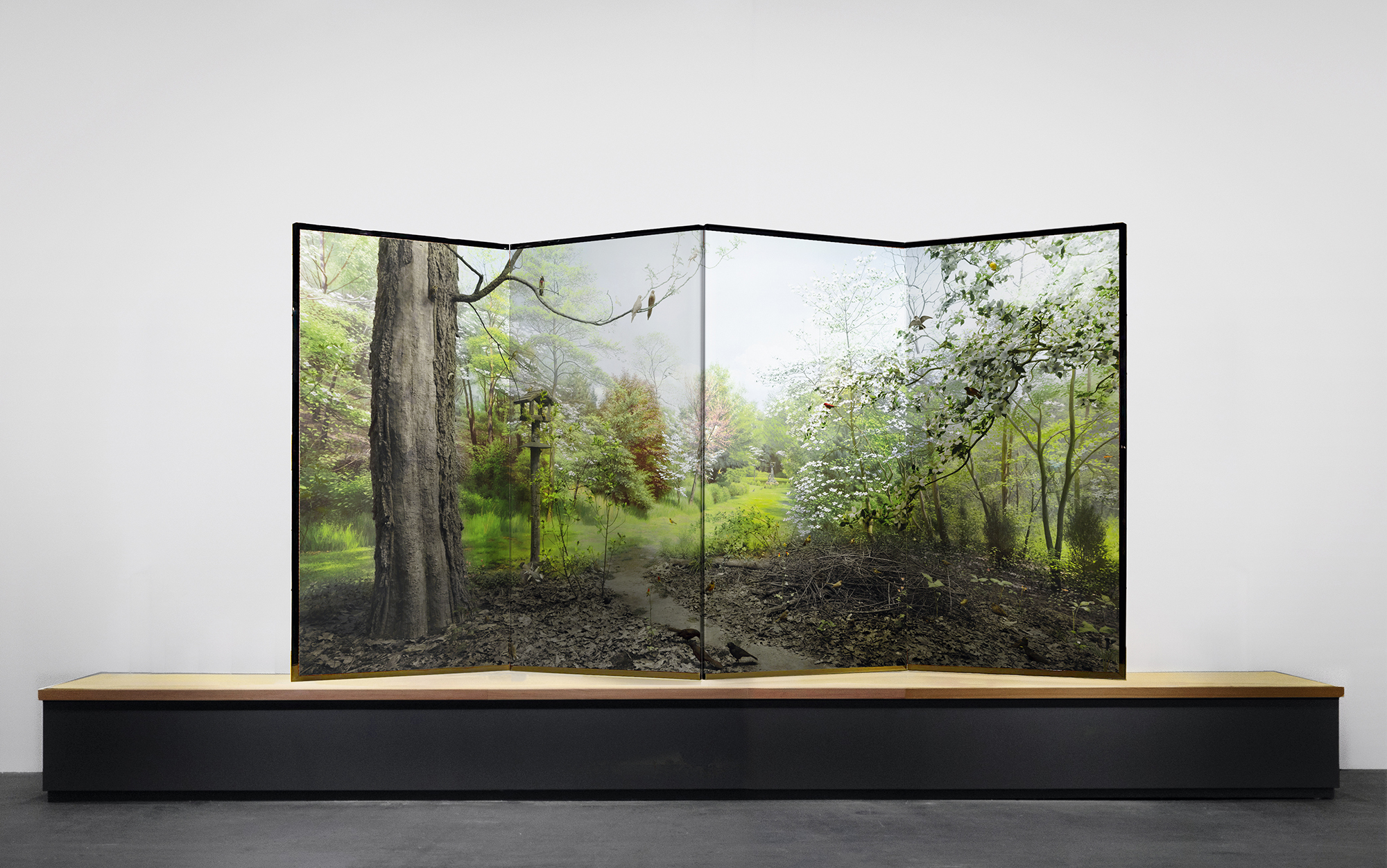
All photographs © the artist and courtesy Fraenkel Gallery, San Francisco; Gallery Koyanagi, Tokyo; and Lisson Gallery, London
For this final photoshoot, Sugimoto used color film—a first for the series. He returned to a diorama he shot before, in black and white, depicting a path winding through a bird sanctuary on Long Island. Although dozens of birds perch and flit through the blooming trees, in gray scale they’re difficult to spot, their bodies well camouflaged. In color, the scene resembles an Impressionist painting: a scarlet tanager, practically invisible in the earlier print, is a shock of red among the dappled patches of pink, white, and green.
Over time, Sugimoto has increasingly trained his lens on overlooked dioramas showing ecosystems devoid of central, spectacular subjects. In these serene landscapes, the artist sees prophetic visions of a posthuman world.
“Humans should be punished by nature,” Sugimoto told me recently, gesturing at a nearby window. “These skyscrapers—so unnatural.” Years ago, the artist could see the George Washington Bridge, about nine miles north of Chelsea. Now, glossy spires block the view.
Sugimoto takes comfort in the thought that humans aren’t long for this world. “Nature will survive,” he said. The artist likes to imagine vines and wild grass overtaking the natural history museum uptown, its roof collapsing on the dioramas, and even his own Odawara Art Foundation in Japan in ruins. Thousands of years from now, he says, the stones will still look beautiful.
This article originally appeared in Aperture No. 264, “Stop Time,” guest edited by Hiroshi Sugimoto.