Essays
How American Photography Was Forged in the Mines
A tool for depicting the industries that shape contemporary life, photography is also enabled by a system of extraction that often goes unseen.
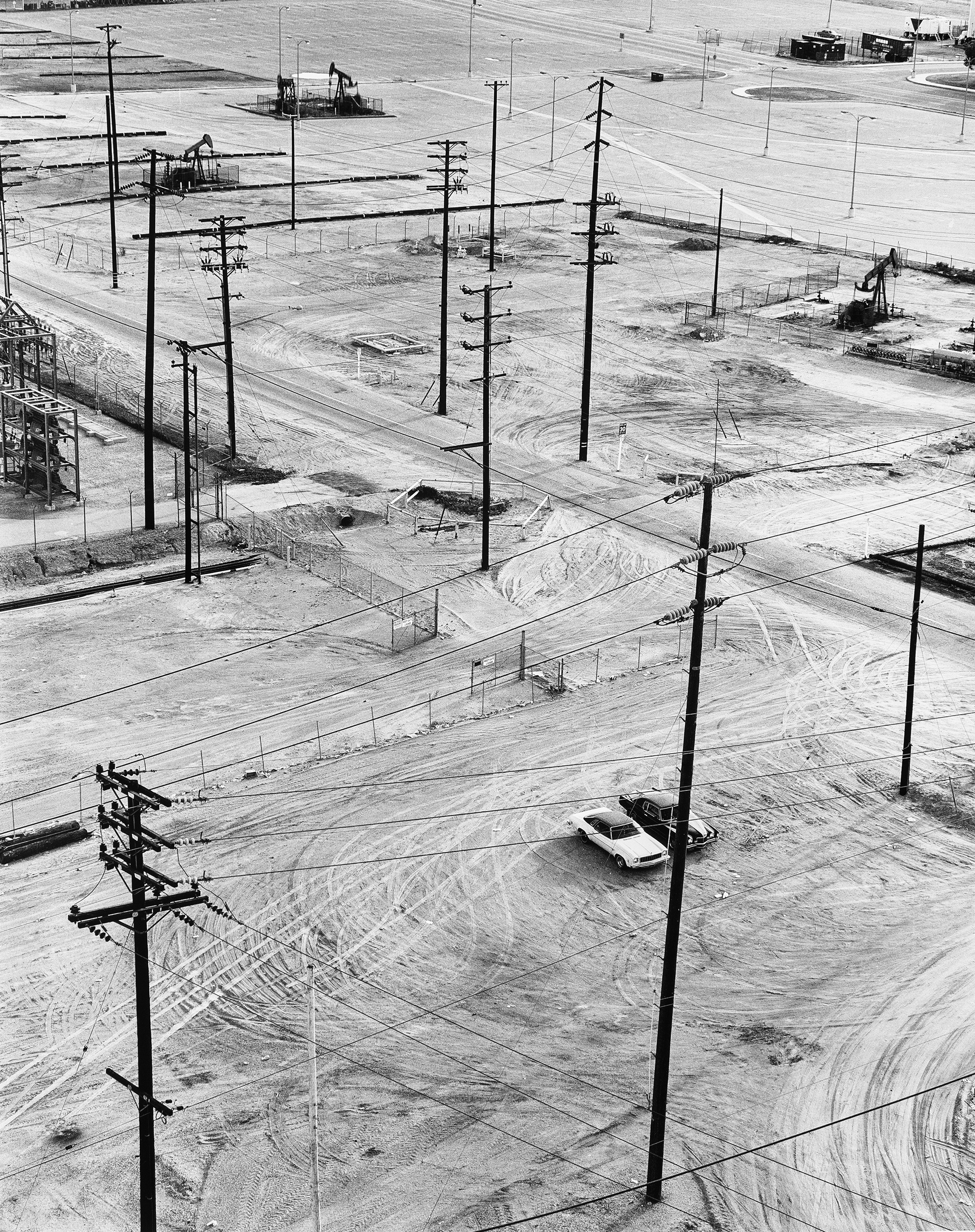

If you spend much time in the American West, the indelible traces of mining are impossible to miss. From abandoned shafts and ghost towns to gleaming refineries and places newly resplendent with fancy houses and fancier pickup trucks, the perennial boom-and-bust shapes the landscape. In Butte or the Bakken Formation, northern Utah or the Navajo Nation, it is clear that American history is a procession of resources being wrested from lodes far beneath the surface, its modernity a great speculative venture.
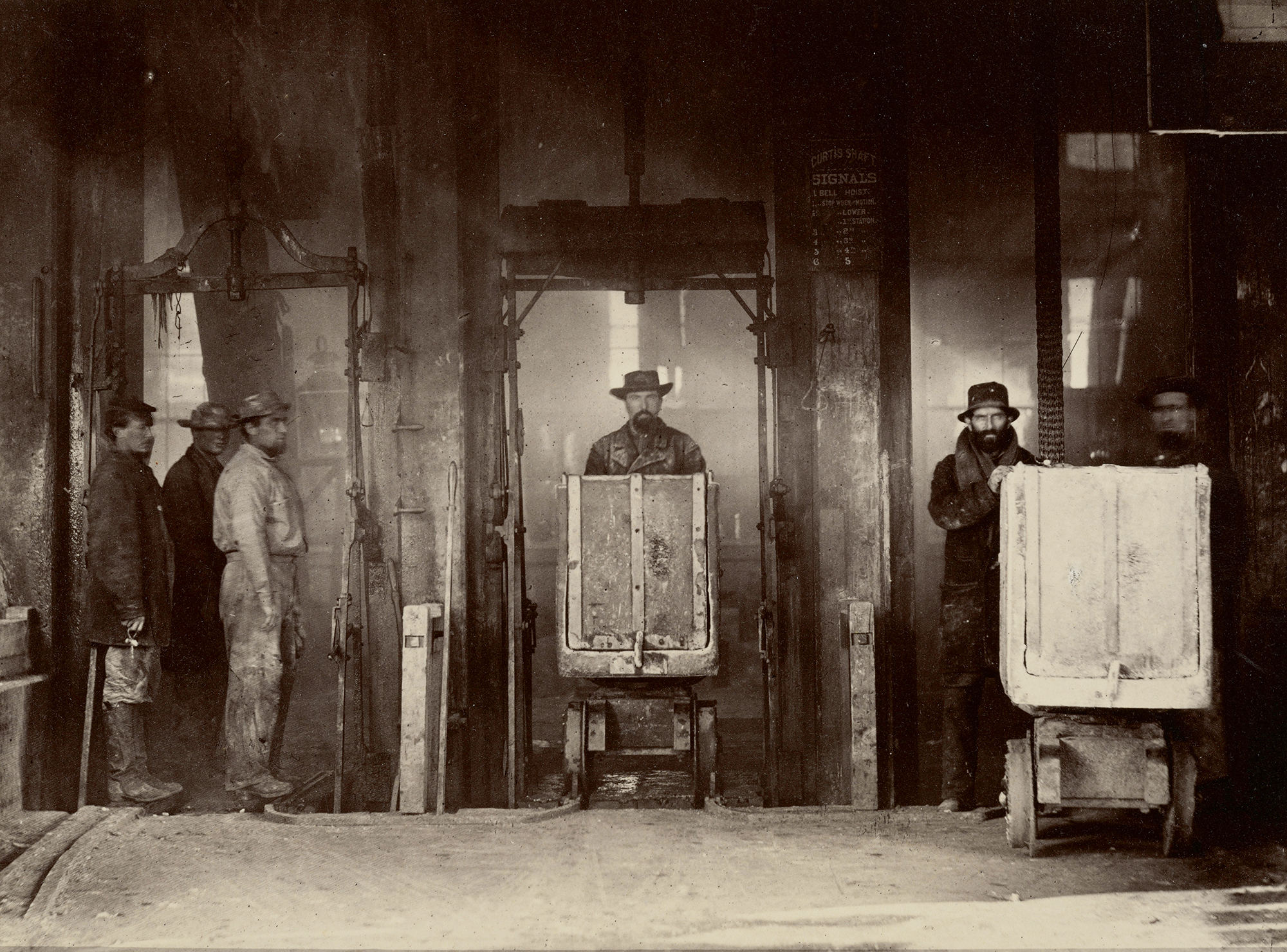
Photography’s history, too, is a mineral one. As a spate of recent ecologically minded scholarship reminds us, the act of recording photonic energy is metallurgy in miniature: precious amalgams activated by other chemicals affixed to copper or tin. The rise of photography in the 1840s was made possible by new strikes of silver and gold. And many of those early camera operators set their lenses on those doing the sluicing, digging, and refining. Timothy H. O’Sullivan was famous for his battlefield images and harsh framing of the West’s Rocky Mountains, but he was also among the first to document the rush towns of Nevada that cropped up after the Comstock Lode was found in the territory in 1859. From the beginning, American practitioners worked to forge new genres of portraiture and landscape photography centered around these pockets of extraction.
Today, extraction is a buzzword. Emerging from ecological humanities and theories of the Anthropocene over the past decade, it can now mean anything exploitative or inequitable, especially in economic relations. In mining history, the term simply describes the laborious—often brutal—process of moving matter from one place to another, converting it from its rawer forms into more refined yields. Extracting is something humans have done all over the world for millennia, and it was the key driver of many of the colonial endeavors that transformed the planet since the fifteenth century. Visualizing such a sprawling terrain is an elusive task, but one to which photography’s relentless archival bent is well suited. Accordingly, the exhibition Beneath the Surface: Mining and American Photography, which opened a multi-city tour this May at the National Gallery of Art in Washington, DC, and this October at the Milwaukee Art Museum, draws together some 150 works and makes explicit an undercurrent running through the medium’s nearly two-hundred-year trajectory.
From the beginning, American photographers created genres centered around pockets of extraction.
Marshaling such a vast range of objects could have been a task without end, spanning the gamut of countless corporate, popular, and fine-art photographs. Based on my conversations with the curators, Diane Waggoner and Kristen Gaylord, Beneath the Surface is a trenchant exhibition—one that shows American mining as not just a Western story but one that crisscrosses the United States, not merely a curiosity of a subset of photographers but a leitmotif visible in unexpected places. According to Waggoner and Gaylord, this focus allows viewers to newly “understand photography as a central tool in both depicting and critiquing the industries that enable our contemporary world, and to help us all better understand how photographers have deployed it throughout the medium’s history.”

Aperture Magazine Subscription
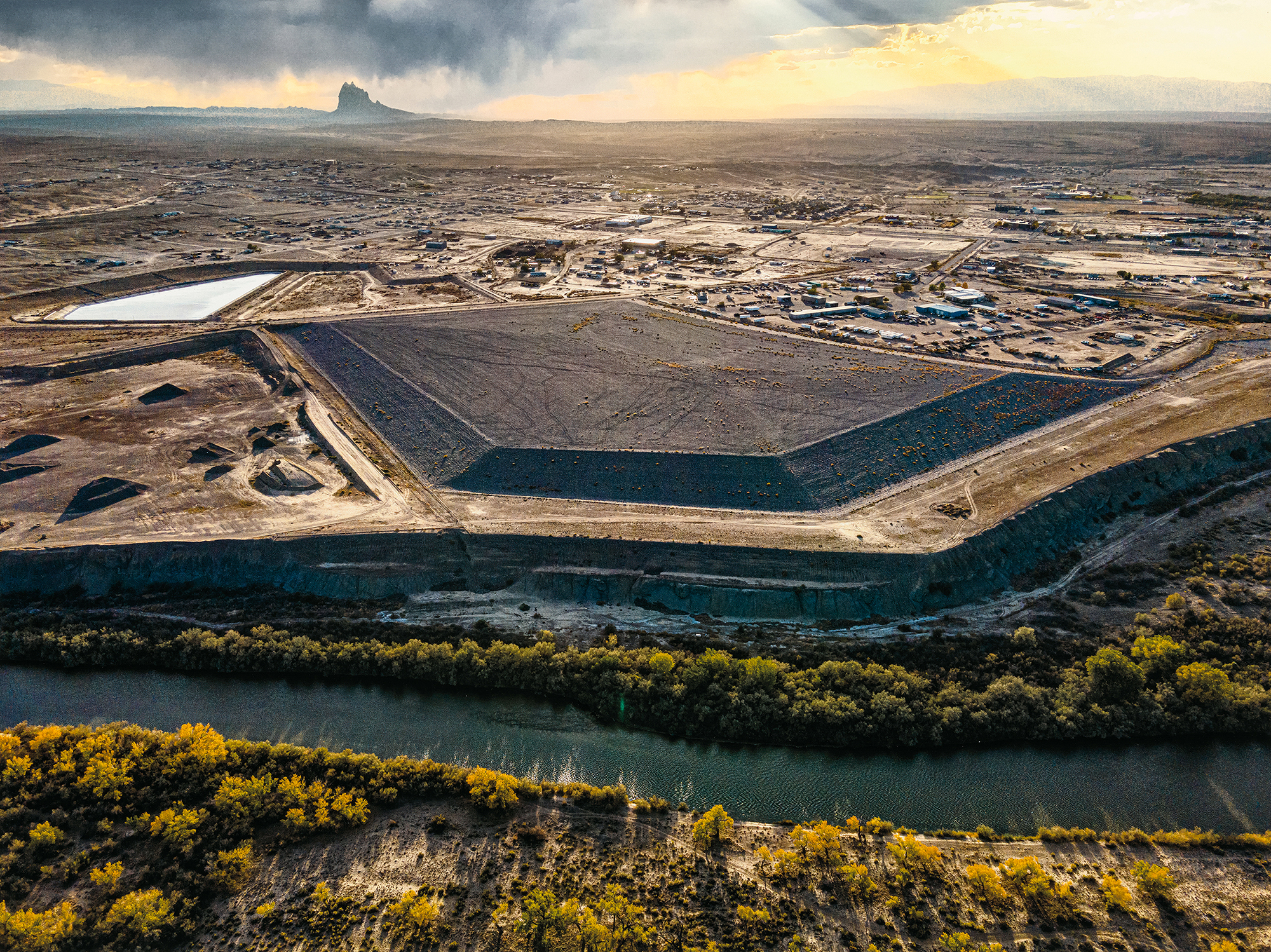
Much recent writing on photography and mining focuses on the connections between extractive industries and colonialism, stretching back to the Iberian quests across the Atlantic in search of precious metals and up to our current moment. Even now, a scramble is on for rare earth metals to power our cars, microchips, and military technology. Versions of this story wend through Beneath the Surface, as in several works by the Diné artist Will Wilson that adapt the surveillant mode of the aerial image to reveal the insidious cycle of a colonial paradigm that persists out West: the speculation of new minerals on Indigenous land, the abandonment of those who live there, and the depredations of the waste left behind. His Shiprock Disposal Site, Shiprock, Navajo Nation, 36 (2020) foregrounds a sprawling pentagonal complex in New Mexico that one might mistake for a Michael Heizer earthwork. Off in the distance, storm clouds dapple a high desert sunset near the titular Tsé Bit’a’í (the Navajo name for Shiprock), a rock monolith of cosmological significance to the Diné. In this way, Wilson juxtaposes two kinds of mapping—the ruthless abstraction of the surveyors’ grid and the emplaced topographies of the people on the ground.
Courtesy the artist and Haines Gallery, San Francisco
Tens of millions of tons of uranium were cleaved from Indigenous land during the twentieth century, used to make warheads, reactors (J. Robert Oppenheimer built his bomb just a few hours away), and X-ray photography. The disposal site contains the radioactive residues of that process. New Mexico is honeycombed in this way, with deep caverns from which ore was taken, and others in which its dangerous by-products are entombed. Just hidden from view in Wilson’s landscape is the San Juan River, a fragile lifeline in this arid region.
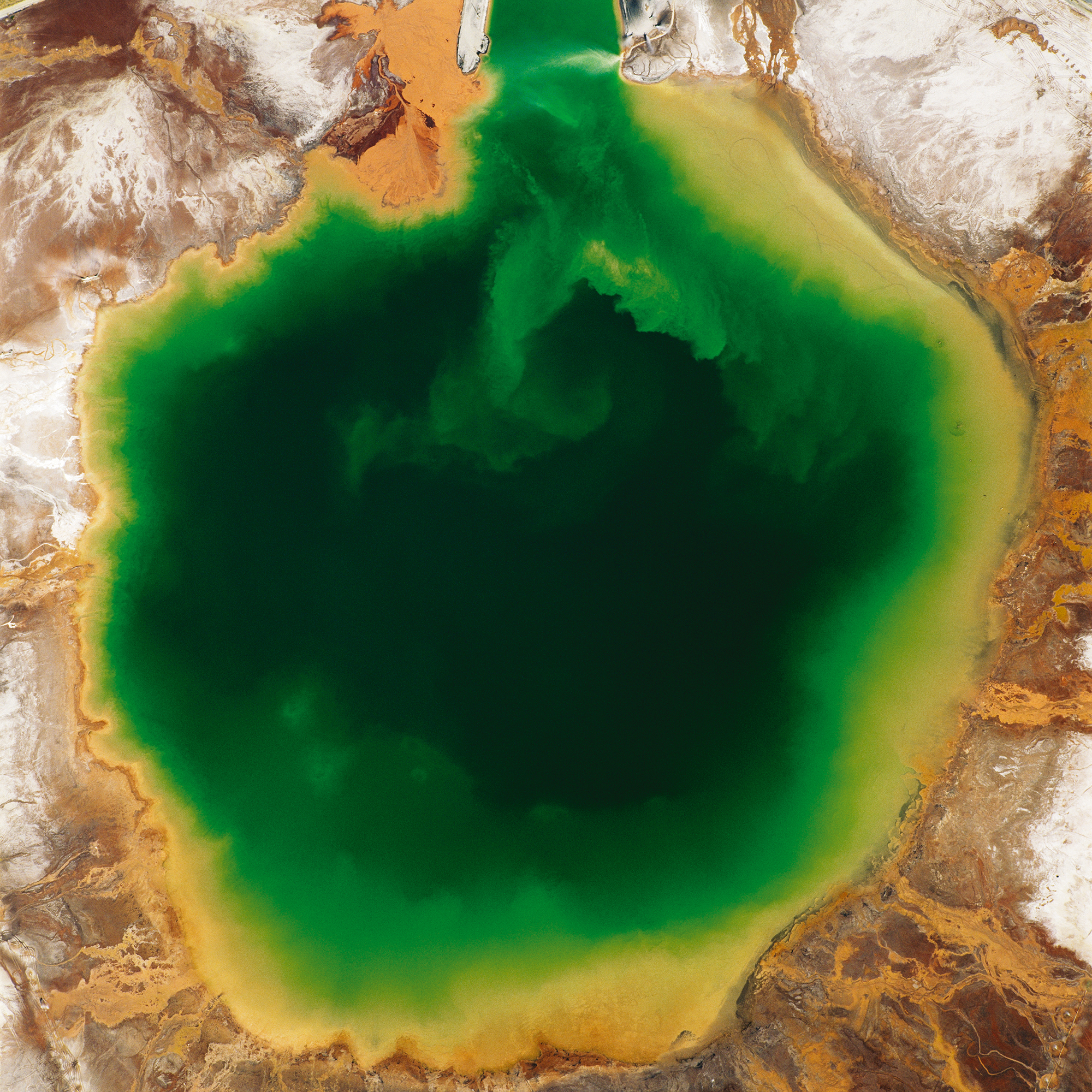
Still, photographers have long known that a perverse beauty persists in such instrumental images; even the chemistry of toxicity has its chromatic appeal. This is especially true in the hands of David Maisel, whose interplay of the photographic and painterly has long sought to chart the tailings and holding ponds left in the wake of mining industries. Gold processing, for instance, relies on cyanide and sulfuric acid treatments, and yields contaminated wastewater, laden with heavy metals that pollute the surrounding ecosystem. Maisel notes the asymmetry, that “the word pond connotes something idyllic, perhaps a site where Thoreau might reflect on the natural world. . . . But no human-made tailings pond is wholly impervious to failure; they are essentially earthen dams.” His American Mine (Carlin, Nevada 1) (2007) depicts such a pond, which seeps across the frame in what Maisel calls a cyanide-infused “lurid green.”
For both Wilson and Maisel, this tension between the aesthetic allure and political-economic critique captured in their work needn’t be resolved. Describing his depictions of Nevada’s Carlin gold district, Maisel told me, “We may be seduced by its beauty and then feel a sense of betrayal when we comprehend the darkness of its subject. I like that contradiction, that ricochet between beauty and horror, seduction and betrayal.” And given their siting in desert basins removed from most Americans’ daily lives, this sort of mapping is all the more urgent. At the same time, the products and wealth generated by those sites suffuse every facet of our financial system and built environment. This is one reason LaToya Ruby Frazier’s many series foregrounding the rust belt back East continue to resonate—because they show us the dense social worlds emanating from the more familiar landscapes of the mill, foundry, or factory.
© The Richard Avedon Foundation

© the artist courtesy Gladstone Gallery, New York
Frazier was raised in Braddock, Pennsylvania, where Appalachian coal country converges with the industrial imperium of the early twentieth century. This Pittsburgh region was built on steel, a beacon for a new middle class and Black families on the Great Migration. But by the time of Frazier’s childhood, in the 1980s, much of the US Steel plant and its jobs were gone, while the toxicity remained. She and her family were left to contend with a contemporary ghost town, where even the local medical center closed its doors, leaving the borough to the vagaries of foreclosure or gentrification. One of several Frazier photographs in Beneath the Surface is drawn from her celebrated photo-essay of domestic interiors. Another shows the Monongahela River arcing picturesquely around two remaining operational furnaces, interlaced by highway and railcars: The black-and-white scene was taken in 2013 but could be a postcard from another era, in which such vernacular architecture manifested the mined world in human terms.
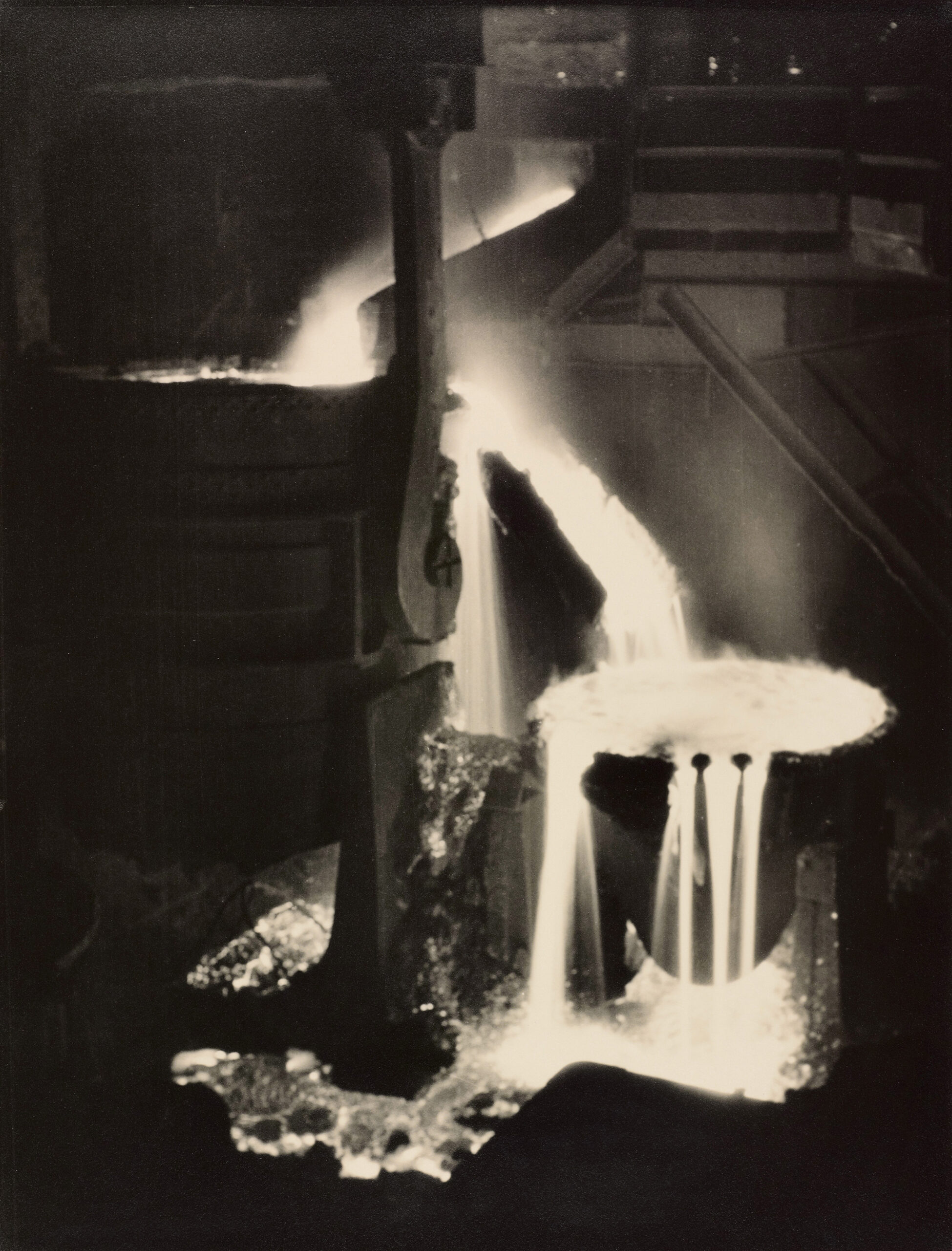
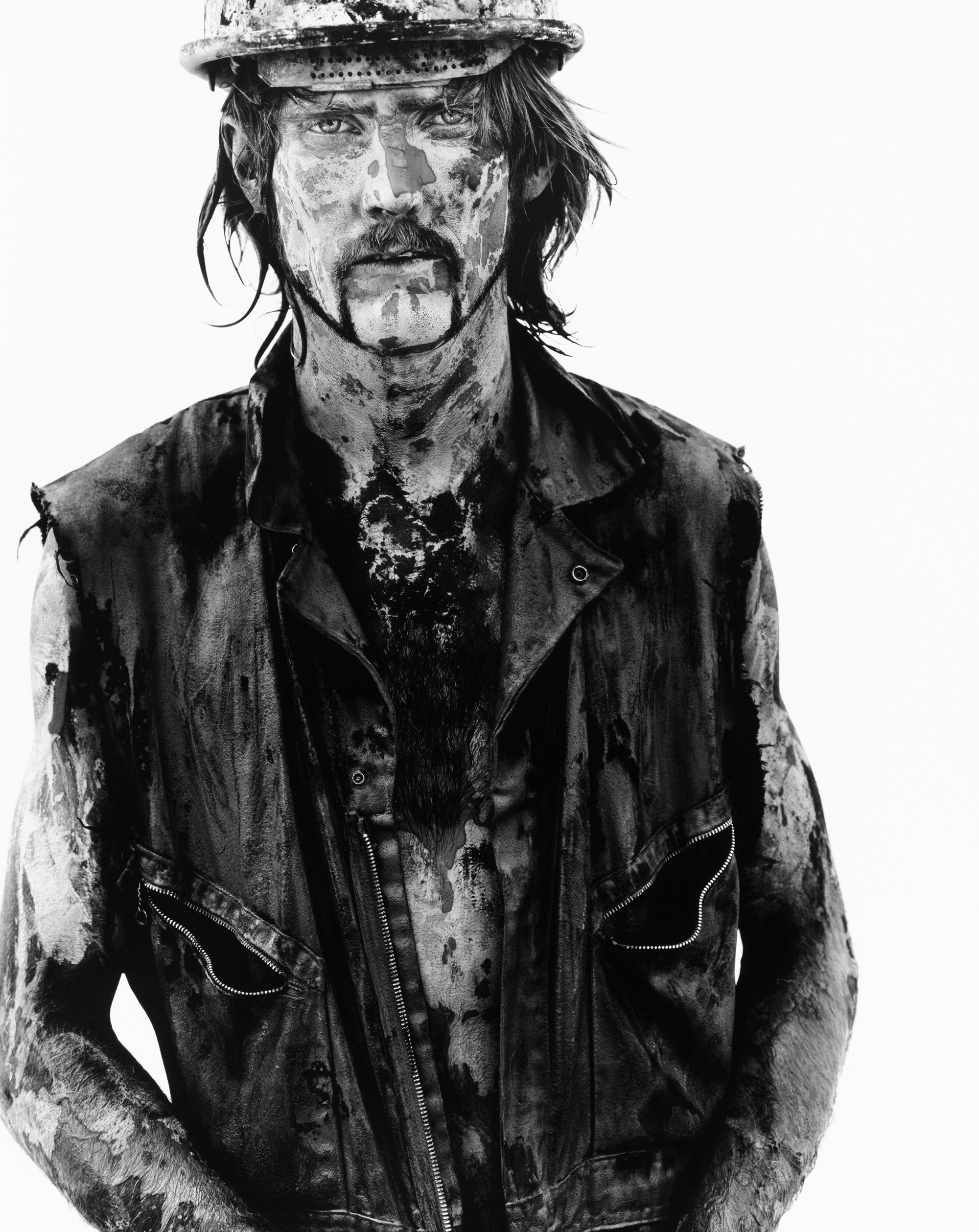
For all the power of these industrial topographies, Frazier is best known as a portraitist of the American working class. In this way, her immersive projects are of a piece with journalistic forebears such as Gordon Parks and Margaret Bourke-White (both featured in the show, with their entrancing geometries of oil pipelines and poured molten ore, respectively). Yet Frazier’s contemporary icons breathe in new ways in Beneath the Surface when seen alongside a host of anonymous mine workers captured in the antique tonalities of the nineteenth century. While extractive capitalism is the structure in which modern mining unfolds, that same mining is done by the countless humans toiling at the ore face. This has always been rough labor conducted at excruciating temperatures in the stygian depths. There is a reason that mine head frames (which hoist people, animals, and ore up and down their cableways) are called “gallows”: Drowning, explosion, asphyxiation, and tunnel collapse have always been present dangers; deafness, silicosis, black lung, and other maladies stalk those workers years later.
Beneath the Surface’s task, then, is to strike a difficult balance, telling a story of extraction from its widest conceptual angles while grounding it in the human tableaux in which involute systems are animated. It is an important time to revisit this American story, not only because versions of it are playing out around the world right now but also because we are still navigating the contradictions and residues of a modernity hewn from the mines. Photography, it is clear, has long drawn our focus to the stakes of that modernity: It’s there in what and how we consume, where we prospect anew, and in the forms of solidarity we seek. Just because what happens beneath the surface so easily eludes our vision does not mean it does not reverberate up here in the light.
This article originally appeared in Aperture No. 262, “The End of Nature?”, Spring 2026.