A War Photographer Returns to the Battlefield
Emanuele Satolli speaks about documenting conflict zones in Ukraine and the Middle East—and why it’s essential to see difficult images in a photobook.
Emanuele Satolli, Edirne, Turkey, March 2020
Ten days before Russia launched a full-scale invasion of Ukraine on February 24, 2022, the Italian photojournalist Emanuele Satolli arrived in Kiev. He received an assignment from The New Yorker and traveled with the writer Joshua Yaffa to the Eastern Donbas, where they covered the opening weeks of a war that captivated global attention until other wars began in other places. Satolli studied journalism in Turin, Italy, and turned to photography as his primary method of storytelling. In 2015, he moved to Turkey, where he was based for nearly seven years while documenting the fall of ISIS in Iraq and Syria for outlets including Time magazine. Later, as the war in Ukraine pressed on, he published numerous stories for The Wall Street Journal, including a devastating account in January 2023 of a group of civilian soldiers tasked with cleaning up hazardous sites on the battlefield. As Satolli followed them on a mission in Sulyhivka, one man triggered an antipersonnel landmine and died instantly. Satolli photographed the aftermath.
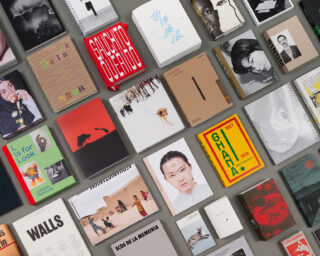
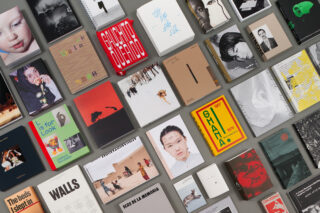
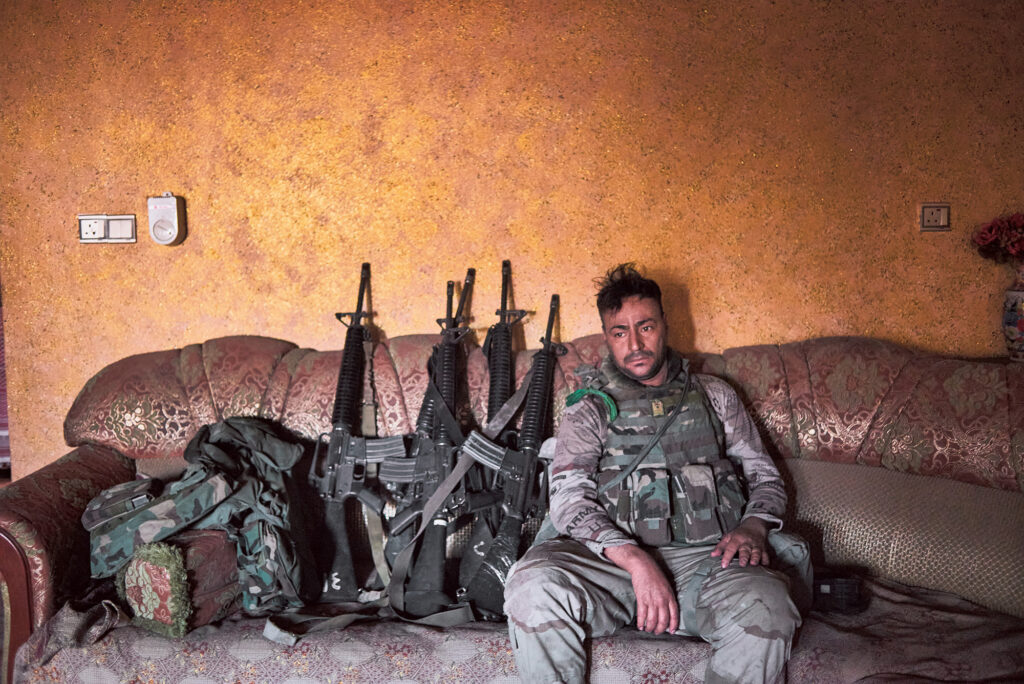
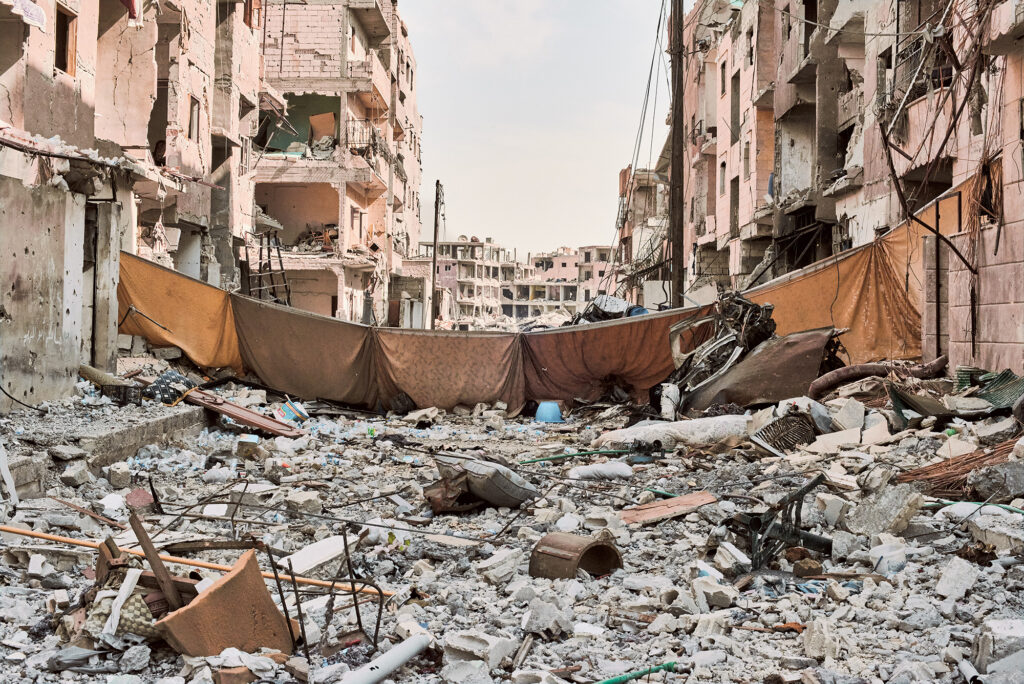
While Satolli often made thousands of images on assignments across the Middle East, North Africa, and Ukraine, only a handful were selected for each dispatch he published. There was more to the story, and to his experience on the front lines. How could he give form to what remained unseen? Late at night, whether in Mosul or Raqqa, Beirut or Bakhmut, he would review images to send off to his editors, and the rest would be stored on his computer. That vast archive is the source for his book, That Thing That Never Vanished (2025), a harrowing chronicle of war and conflict that covers ten years of Satolli’s work, much of which hasn’t been published previously. Printed on a heavy, uncoated paper stock, the images are sequenced without captions, dates, or references to locations. The idea, Satolli says, was to attain some distance from the imperatives of journalism and to stage for the reader a visceral experience—to allow for clues to emerge from the landscape about where and when the events he witnessed took place.
I recently spoke with Satolli about his career covering conflict, how newspapers prepare photographers to work in war zones, and why it’s essential to see difficult, even horrific images in a photobook. Satolli was in Doha, Qatar, days before setting off for Iraqi Kurdistan, where he began reporting on how the Kurds have become involved in the latest war in the Middle East, the one the United States and Israel are waging against Iran. In our conversation, which has been condensed and edited for clarity, he explains that the theme in That Thing That Never Vanished is the consequences of war for those who survive and the choices civilians and soldiers are forced to make. The book concludes with a contemplative yet forceful essay by James Marson, the Ukraine bureau chief for The Wall Street Journal. “Thousands of years have passed, and the purposes of war haven’t changed: defending a homeland, a people, a resource—or seizing someone else’s,” Marson writes. “What sends someone to war also remains the same: money, pride, loyalty, ambition.”
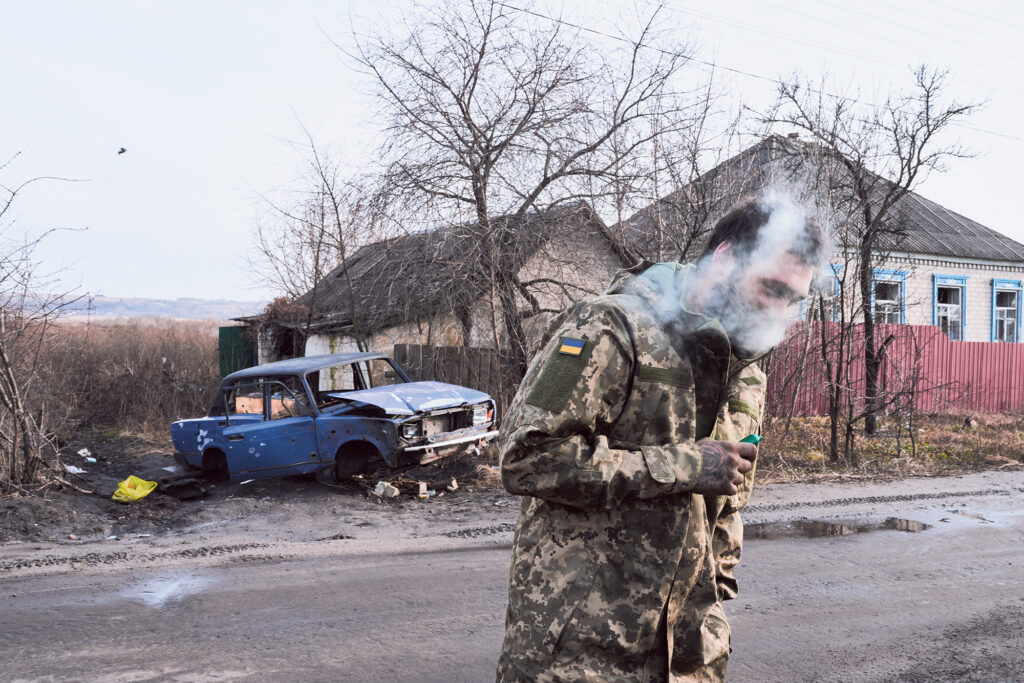
Brendan Embser: The images in your new book are printed without any captions indicating locations or dates in the main part of the book. Instead, the readers can refer to an illustrated index at the end, which has dates and locations and sometimes longer, narrative-style captions. Why did you want to present your work in this manner?
Emanuele Satolli: I work as a journalist. And the main thing as a journalist is that you have to give the location, you have to be very strict about the dates, where you take the picture, the names of the people. But when I had the chance to do the book, I wanted to give back my own reflections about what it means to experience war. I wanted to give the reader the possibility of going from one page to another page without knowing if you are in Ukraine or you are in Iraq or in Afghanistan—the feeling that despite the time and the countries, the experiences of the human condition during war are the same.
For instance, when I’m in Iraq or in Ukraine, I am very surprised when I see soldiers or even civilians who are conscious of the real possibility of dying. Sigmund Freud, during the Second World War, wrote a about the meaning of dying during wartime. And he said that all of us know that our destiny is to die at one point, but we live our life as if we won’t die. You don’t think about dying all the time. But Freud said in war, you have to believe in this destiny. This is what I experienced in all the different conflicts. So, I want to give this sense back to the readers. That’s why I didn’t put the captions. That’s why I want to give the suspension that war evokes.
Embser: Many readers probably will have never been to Iraq or Ukraine. Do you feel it’s okay that, as you go through the book, you don’t really know where you are at first and may feel a sense of confusion?
Satolli: That’s the aim, actually—to have this confusion. You have to feel what is behind the news. I wouldn’t totally avoid the text and the captions. They are at the end. So, let’s say you do your “trip” page by page, and then at the end, you discover everything. But the first step is just a suspension, the visual narration of the work.
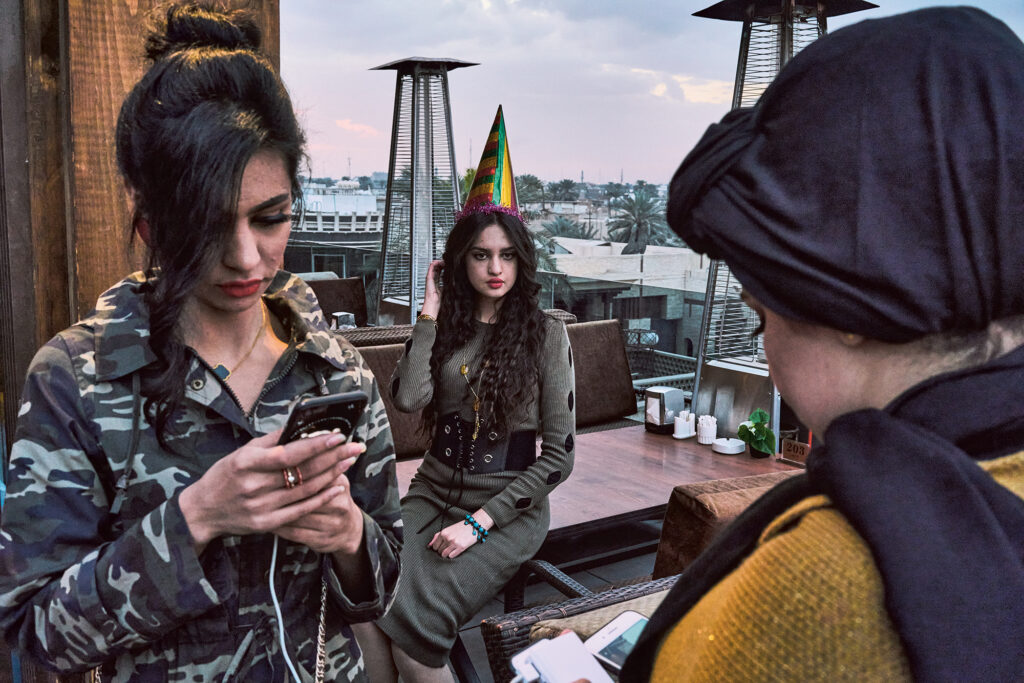
Embser: Were the majority of the images in the book originally published elsewhere? Or did you go back into your archives and pull things that maybe had never appeared in a magazine or newspaper?
Satolli: When I work with a newspaper or magazine, they want the pictures every day. I shoot and then I go back to the hotel, I make a selection, I use Lightroom to fix a little bit of color or the tone, and then I send the pictures with the captions. The pictures are related to what works for the journalist, for the needs of the photo department. For the book, I said to myself, Okay, if I want to do a book now, which is going to be different, I have to see the archive again from the beginning, and I have to make a new selection. After the first talk with Stu Smith, the designer from GOST, I spent more than three months on my own looking at the raw files from the beginning to the end.
Embser: How many were in the raw files?
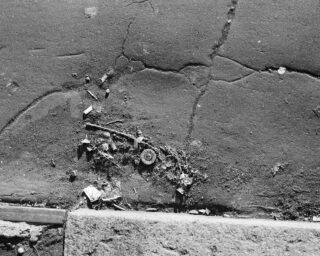
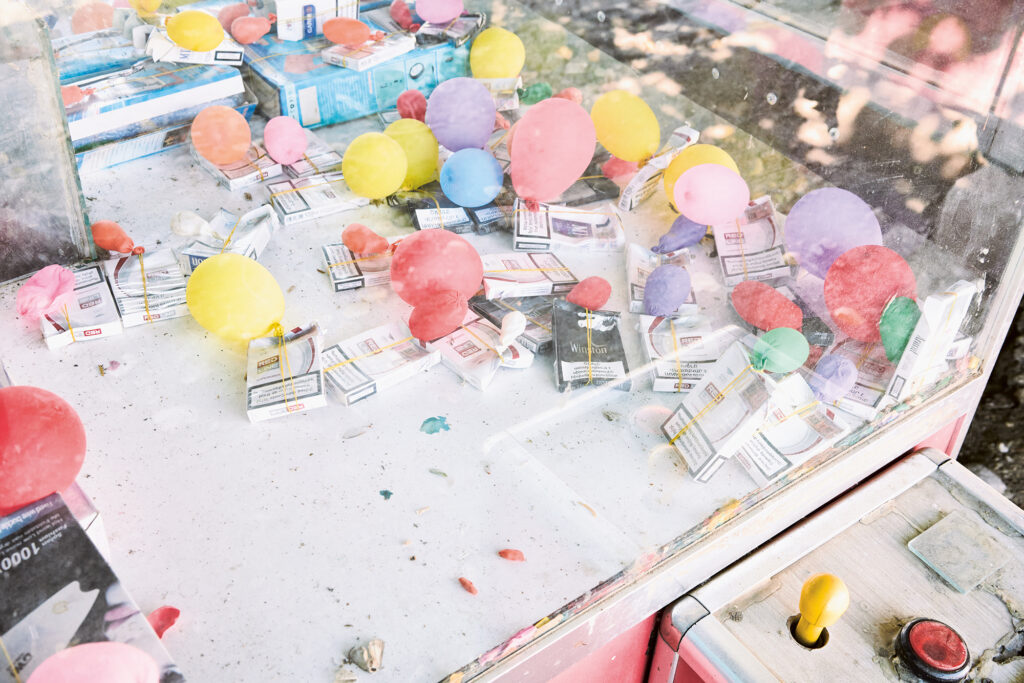
Satolli: Thousands. This was something that I did almost every day for almost three months. I saw some pictures that I hadn’t seen for ten years and some people that I didn’t even remember that I met. It was also important to choose some pictures that were abstract. For instance, there is a picture of this box of cigarettes that I took in Nagorno-Karabakh in Azerbaijan. They are inside the machine where you go down with the claw. I didn’t send it to any editor. I thought they will never publish this picture because it says nothing about the war. But in this case, for me, it says a lot. It gives the sense of the time that had passed and that, because of the war, things are abandoned.
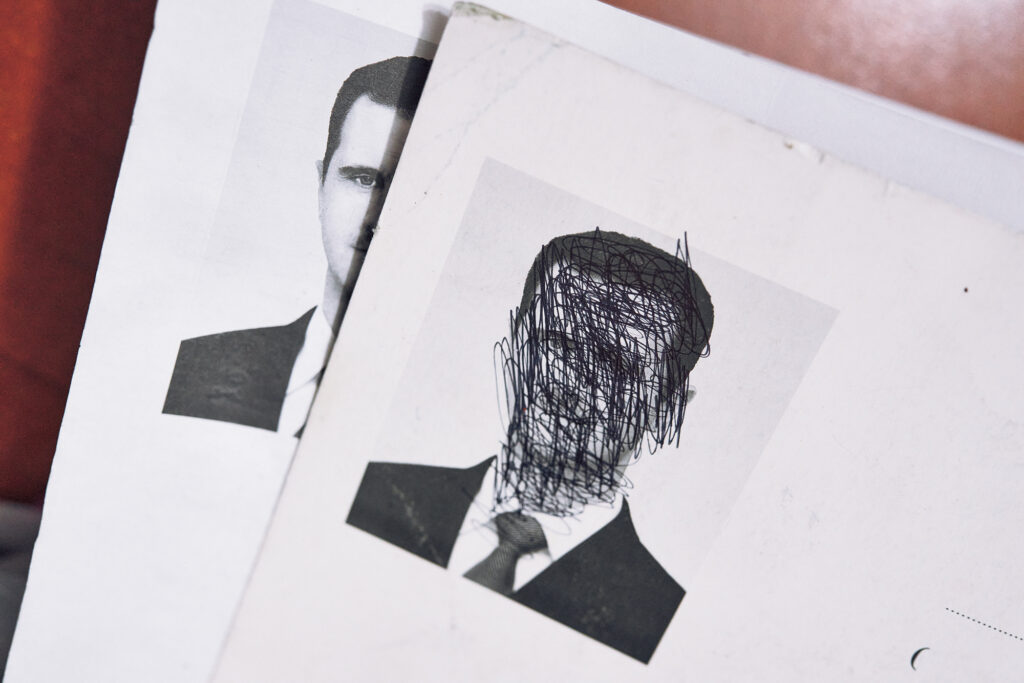
Embser: In another image, you show a picture of Bashar al-Assad’s face scratched out.
Satolli: This is one of the pictures I shot for The Wall Street Journal, but they didn’t publish it. But I wanted to put it in my book also because it’s the attendance book for a classroom. That scratch on his face was something unthinkable even two weeks before, when Assad was in power. I was working with a fixer after Assad fell. When I entered Syria and we passed in front of a military base, the fixer said, “Here, two weeks ago, you couldn’t even point with your finger at the military base. Otherwise, you would’ve disappeared.” And the same probably would have happened to the kids, to the family, to the parents of this kid who scratched the face of Bashar al-Assad. So that picture with the scratch of the pen on it was super strong because it was something showing that, after fifteen years, the people were finally able to deface the dictator. The meaning behind it is very deep.
Embser: You also have several violent and disturbing images in the book, and there’s even a warning on the publisher’s website about your book containing graphic content. Why was it important to include those very difficult images in the book?
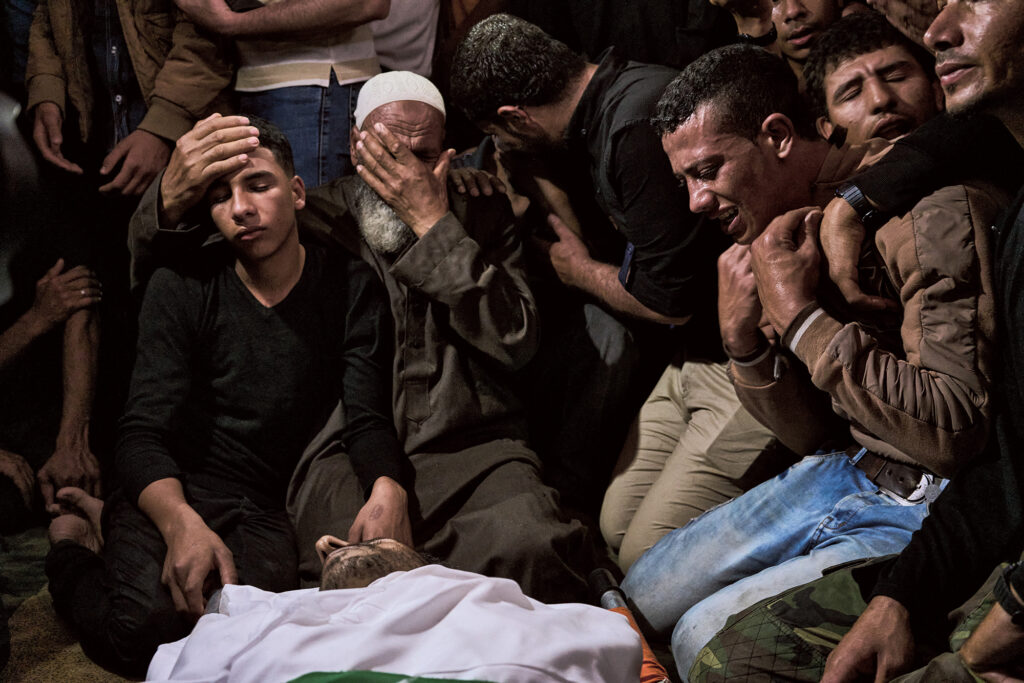
Satolli: My task is to document. So, if there are dead bodies on the ground, I take a picture of the dead bodies. I know that most of the time, the newspaper won’t publish images that are too violent, but I take them anyway. If a picture is too strong, nobody will see it. It is just in my archive. In the book, there is one picture of an alleged ISIS fighter with his head cut off next to him. I wrote an email to Stu and I said, “I think this picture is too strong. I’m not sure I want to put it in.” But he said, “War is also these things. The book is also a chance to show this part of the war.” In a war, on one side is the real possibility of dying. But on the other side is the real possibility of killing.
When I covered the Mosul operation, I was with the Iraqi army, and sometimes I slept with them in the field near a destroyed building. The Iraqi army members, they were doing video calls with their daughters in Baghdad, and they were saying, “Habibti, habibti, my love, my love. I love you. How are you?” They were super kind. And then in the morning, they wake up and they start fighting. And some of them, when they got an ISIS fighter, they would treat them very, very badly. I mean, they were very evil. That picture of the alleged ISIS fighter with his head cut, the belly open—I mean, it was a sign of how far the human condition can go. When you are in a war, you can become everything. This is my idea.
Embser: Could you talk a bit about the editing? I’m particularly interested in your decision to include gatefolds and sequences that give you a cinematic take over the course of multiple frames of one scene. And in the index, for those moments, you also have much longer narrative captions that explain what’s going on. How did you arrive at that concept for bringing the reader through this journey?
Satolli: At the beginning, we agreed that we didn’t want chapters. We didn’t want to divide by country. We didn’t want to divide by time. So, we mixed everything, but then we said, Okay, we have some sequences that they are quite strong. Then we decided to put together these gatefolds. They are like a break inside the narration. And for these sequences, I wanted to add my direct experience.
Embser: Did you write those captions at the time in the form of a journal or a diary?
Satolli: No, when I was reflecting for the book.
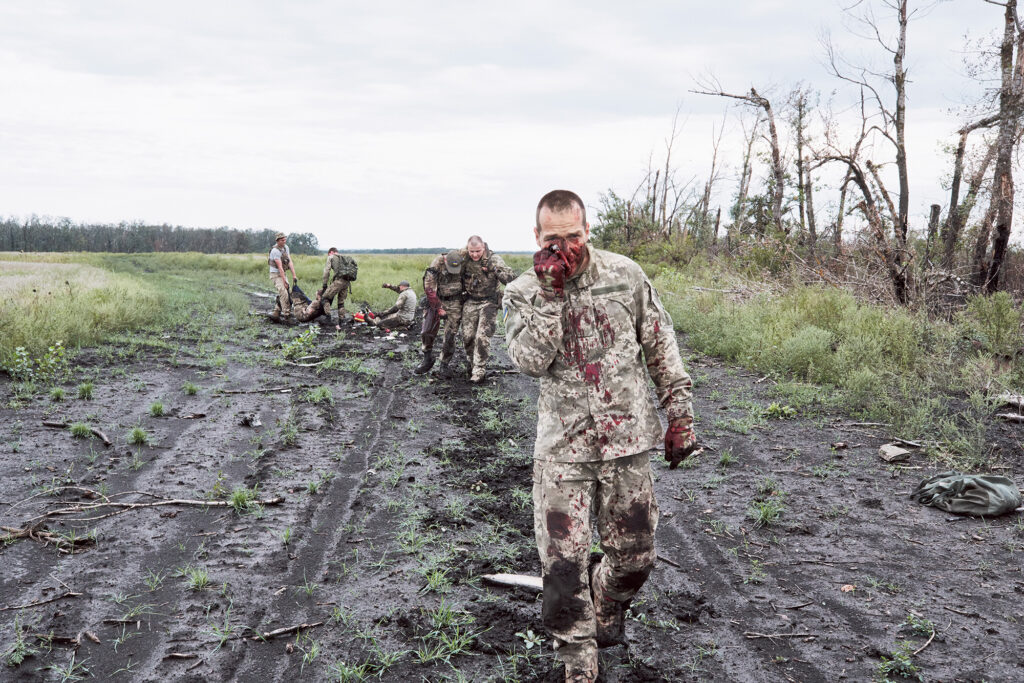
Embser: The gatefolds provide an opportunity to bring the reader into a very intense event in a way that you probably wouldn’t be able to do in a newspaper or magazine where there’s limited space. Is that right? For example, across eight images in a gatefold and a narrative in the index, you describe a harrowing scene in Sulyhivka, Ukraine, in 2022 during which you and James Marson, the Ukraine bureau chief for The Wall Street Journal, followed a group of specialists called upon to retrieve casualties in no man’s land on the eastern front. As you moved single file through a field, a soldier at the front of the line triggered a land mine, and you photographed the ensuing chaos.
Satolli: Exactly. When we published the story in The Wall Street Journal, they included only a few pictures from the event. In the gatefold in the book, some pictures can feel like a repetition because they’re quite similar, but they’re not, and the sequence is very strong. It’s like you’re walking on the minefield.
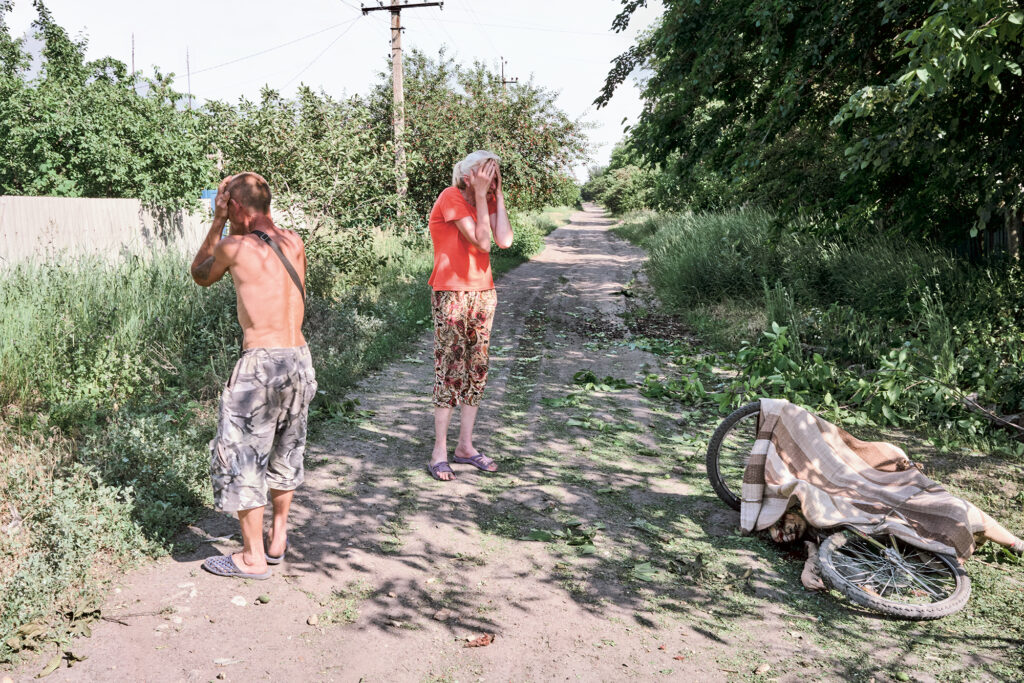
Embser: For me, one of the most emotional images in the book is from Ukraine in summer 2022. With an incredible sense of drama, you capture a scene of two people on a grassy lane discovering the body of a person intertwined with a bicycle. And when I read the extended caption, I learned that this person was a thirteen-year-old girl named Nastia.
Satolli: I was with a colleague at a school being used for civilians to get food, to get aid. One of the guys who was working there said, “Look, one girl was just hit by a mortar.” He said, “She was here this morning because she was volunteering here. She’s a young girl.” And we said, “Can you show us where it happened?” Google Maps showed us the position. We went there by car, and we arrived together with her relatives. The girl was hit in front of a house, and the people living in the house covered her with a blanket. When we arrived, the relatives removed the blanket. When they recognized her, I was there, and I took this picture because it was a very strong moment. This girl was killed just going home after working in the school helping civilians.
Embser: I wanted to ask about how you got started in photojournalism.
Satolli: I studied journalism in Turin. It was two years. It was mainly writing, but I didn’t really like writing. And I felt that writing was not my way to tell stories. So, when I finished school, I was already into photography on my own. I was developing in a darkroom on my own, but mainly I was taking normal pictures of friends, of the landscape. And then I said, Okay, I should use photography to keep working as a journalist because that’s what I want to do. So, I said, I have to develop a portfolio. And I started doing stories in Italy.
I ended up in Russia doing a story about a drug known as krokodil. It was a story about drug addiction in Yekaterinburg, which is a big city in Russia where there was a problem with people addicted to heroin. They were going to the pharmacy to buy painkillers, which they were cooking with other chemicals at home to make an opiate. And then they were injecting it. I went to Yekaterinburg on my own, and I stayed there for almost forty days. It was at the beginning of my career. This was at the beginning of 2013.
Then, in September 2013, I decided to go back. I applied for a new visa, and I bought my ticket. In September, Time magazine published a little story about a few cases of krokodil in Chicago. I wrote to the photo department and said, “Look, you wrote this story, and I did this story in Russia, and I’m about to be back.” On October 15, the day before I left, the editor wrote me back and said, “What’s up?” And I said, “Look, I’m leaving in eight hours.” And then the last email was “Do you want to go for us?” Basically, I got the first assignment from Time magazine eight hours before going back to Yekaterinburg. I did the story and then they asked me to also do a video.
After that, I flew to New York to meet the editors at Time, and then I moved to Istanbul. At the beginning, I didn’t have any clue about how to cover wars, to be honest. But, if you work in the Middle East, you end up covering war because that’s the main news there. That’s what’s going on. When I moved to Turkey, there was a new war between the Turkish army and the PKK [Kurdistan Workers’ Party], and then there was the Mosul operation, then there was Raqqa, and then there was Libya, Afghanistan. That’s how I started covering war.
Embser: How do you prepare for an assignment and how do your editors prepare you?
Satolli: The editors at The Wall Street Journal are really aware of my security. Every three years, they offer me the EFAT [Emergency First Aid Training] course—a course for journalists who are working in a war zone. They teach us how to stop bleeding, how to do CPR, how to recognize if you’re working in a minefield, how to move. And then they run a simulation where they do a kidnapping. I mean, they train us to face some of the situations that you can face in a war zone. When I go for The Wall Street Journal, we have a security team. And I normally have a former soldier who is with me and the correspondent for twenty-four hours, all the time. He stays with us, he’s responsible of our security. The last decision about how long to stay in a place, where to sleep, is on him. If I say, “Look, I have to go to take some pictures in Aleppo,” for instance, he will decide which road to take, where to stay, how long we can stay. And then we also have the security team in New York, in London. We talk with them; we check in every two hours. So, we feel quite safe in this sense. Also, we have an armored car, which is something that as a freelancer you cannot afford because it’s quite expensive. For the Journal, I normally work with the same three or four correspondents who I trust, and we have become friends. We are a good team.
Embser: What about when you’re on your own?
Satolli: When I go on my own, I always try to team up with other colleagues because, for instance, hiring a fixer is super expensive. In some countries, they are asking for about five hundred dollars per day. If you go on your own, you can work three, four days, and then you have finished your money. It’s better to stay with other people to make the right decision—shall we go, shall we not go? Shall we trust this guy or not? It’s better to share with other colleagues.
Embser: And what about emotionally? Having witnessed so many very difficult scenes, are you able to keep some emotional distance from the places that you’ve photographed?
Satolli: The first distance that I have is the camera. When I’m there and I’m in front of some strong situation, my first thought is to get the picture. And with respect, sometimes a subject will say, “No, no”—and I don’t take the picture, of course. But my first thing is about documenting. This is like a filter between me and what happened, but it’s just a temporary filter. Several times, I was sitting in the hotel room in front of my computer, seeing the pictures again, and I had some emotional reaction, quite strong. When I finish and I go home, it can seem a little bit schizophrenic, but I try to do whatever helps to go back to normality. Sometimes, the day before you are in the middle of chaos, where you see people and you deal with their pain and their situation, and then two days later, you are with friends drinking in a bar. But I don’t have to feel guilty, because it’s something that helps me to—
Embser: Have some balance?
Satolli: Yeah, to have balance.
Embser: When Ukrainian journalists go home, they also need to have some balance—but their country is at war.
Satolli: Yeah, exactly. I have this lucky situation where, with my passport, I can choose how long I can stay. This is a big privilege for me, for sure. When I witnessed this minefield accident, it was quite an intense situation. The editors at the Journal really took care of me. At some point, they offered to pay for a therapist for me.
All photographs © the artist and courtesy GOST
Embser: Your book concludes in two ways. There’s a visual index with your captions, where you give all the locations and the stories about the images. Following that, there’s another sequence of images that are portraits of Iraqi servicemen. Why did you make that decision in terms of the design of the book—to set apart these portraits of mostly injured Iraqis?
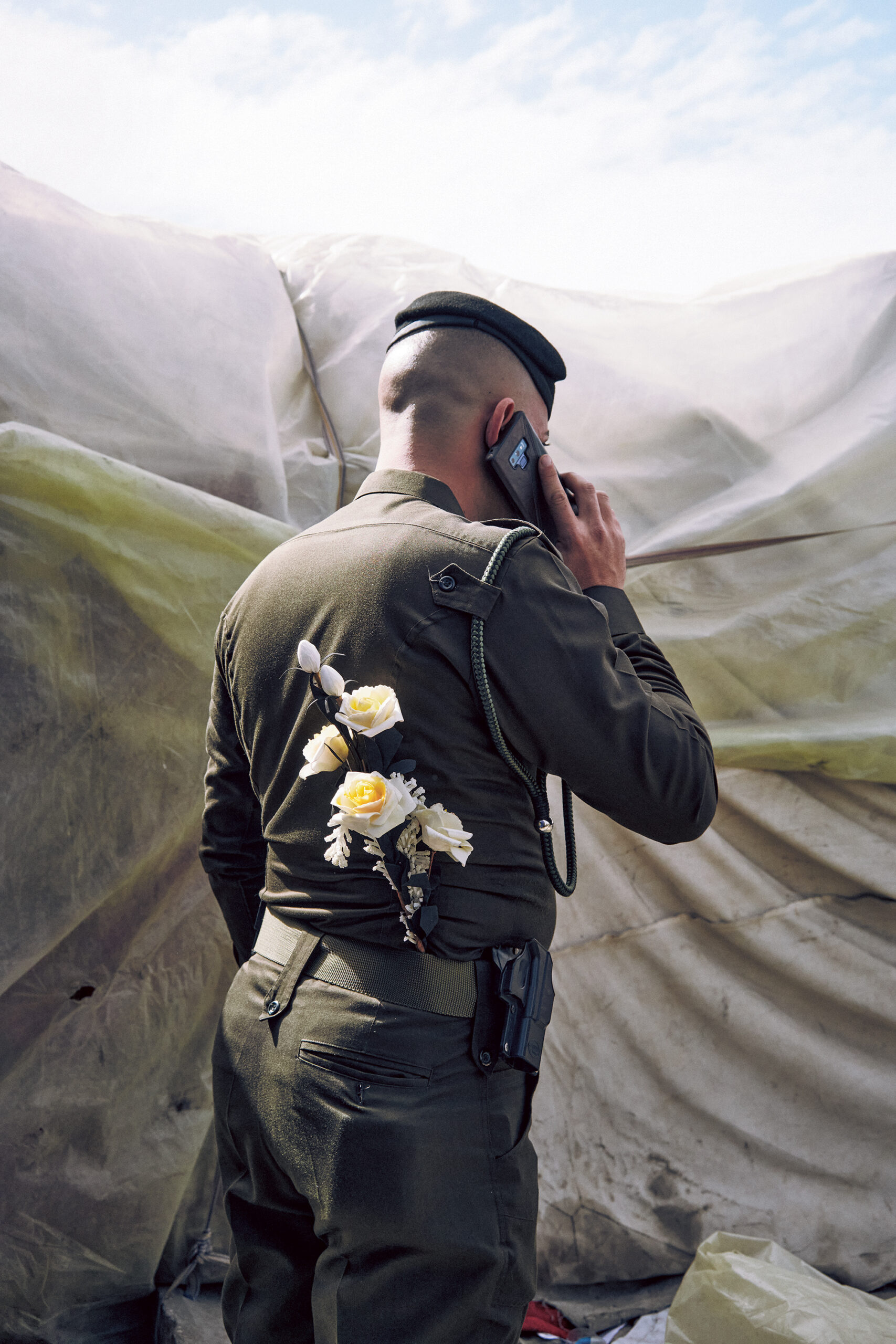
Satolli: When we designed the book, the pictures of the injured soldiers were before the captions. After the sequence of the war images, they didn’t really match together. So, I was thinking, like in a movie, you have the credits at the end, and then sometimes you have something extra. I wanted to put something extra that was a bit different from the rest of the book. It was also a personal project. I went back to Iraq after I documented the fall of ISIS in Iraq and in Syria. I wanted to meet the people who will pay the price forever for fighting against ISIS. You face the war, you’re willing to die, you are willing to kill also. But then what remains? What is the consequence for your life? Is your life changed forever? And when the story’s over, nobody’s going to talk about death anymore. I wanted to put a light on these people whose lives changed forever because of the liberation from ISIS.
Embser: Well, it also connects back to the question you’re posing to the reader: Could you kill or could you risk being killed?
Satolli: The willingness of the people to face one of these perspectives is something that really struck me all the time.
Embser: Finally, the title of the book, That Thing That Never Vanished. Where does the title come from and what does it mean to you? Especially now, given that you’re in the Gulf states preparing to cover another war? Is war the thing that never vanished? Is it memory?
Satolli: Yeah, exactly. When I had the idea to do this book, I started a conversation with an Italian philosopher, Federico Leoni. I want to keep some distance from journalism. I didn’t want to talk with journalists again about our job or what the meaning of war was for us. He said that we have this relative calm of peace in Western countries, but in reality, questa cosa non se n’è mai andata. He said, “That thing never vanished. The war never vanished and probably will never vanish. It’s something that we keep repeating.”
It’s something that unfortunately we are going to repeat. And maybe we have to keep in mind this view to try to understand how to see the conflicts. I think peace is like a balance of energy that stands still until there is another war. War is more normal, unfortunately, than peace. You know what I mean?
Embser: Even if the condition is that the war never vanishes, is it perhaps the role of the photographer to keep a record, would you say?
Satolli: Of course, it’s to keep the record and to keep documenting it. I don’t want to say that I’m pro-war. But I want to be realistic. There is a new war in Iran, and then this war expanded to the Gulf. Even if it ends, then there is the Lebanese war, and then there is the West Bank war, the Gaza war. We are never unemployed, unfortunately, as war photographers. That will never vanish.
That Thing That Never Vanished was published by GOST in 2025.