How Carrie Schneider Made the World’s Largest Photograph
Schneider’s dazzling contribution to the 2026 Venice Biennale transforms a fleeting moment from a Chris Marker film into a monumental installation.
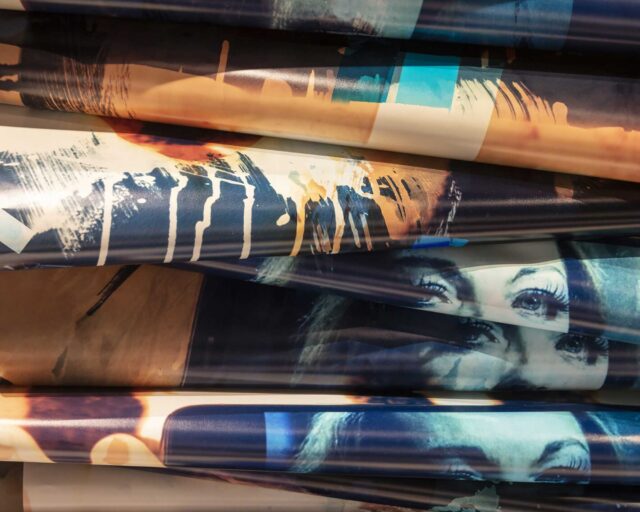
Carrie Schneider, First Living Woman, 2026. Installation view from In Minor Keys, the 61st International Art Exhibition of the Venice Biennale, 2026
“He never knows whether he moves toward her, whether he is pushed, whether he invents her, or whether he dreams her,” says the narrator of Chris Marker’s film La Jetée (1962). The voice is describing the uncertain relationship that exists between the time-traveler protagonist and the unnamed woman he visits in the past, incarnated by Hélène Châtelain—actress, filmmaker, translator from Russian to French, and now the lodestone of First Living Woman (2026), a photographic installation by Carrie Schneider on view in the late curator Koyo Kouoh’s Venice Biennale exhibition In Minor Keys. If a crucial shift of gender were to be made, the narrator’s words might also capture Schneider’s attitude toward the close-up of Châtelain that she pulled from Marker’s film and rephotographed in her Hudson Valley studio, using a room-sized camera to create the largest analog chromogenic photograph ever made. Like Marker’s protagonist, Schneider is caught between an indelible past and a transformative fantasy. And like Marker himself, who called his film a “cine-novel,” she works at the threshold of distinct media forms, producing a decidedly photographic work with relationships to cinema, sculpture, and the internet. Hers is a labor, a laboratory even, in which memory and creation become indistinguishable.
La Jetée is the story of a man marked by an image from his peacetime childhood, an image of a female face that stays with him throughout and beyond World War Three, into a desperate era in which Paris has been rendered uninhabitable by atomic violence. The strength of this mental picture makes him, a prisoner trapped underground in the catacombs, a prized candidate for his keepers’ experiments, which propel him through strata of pastness and ultimately toward the fatal instant on the observation jetty at Orly Airport that had marked him so deeply as a child: the moment of his own death. La Jetée is also, famously, a film made almost entirely of still photographs, save for a few seconds shot on 16mm that appear immediately following the line quoted above, in which Châtelain is framed in close-up, her head resting on a pillow. As the sound of chirping birds swells on the soundtrack, a series of dissolves between stills creates a sequential propulsion that strains toward motion; then, in what feels like a miracle, Châtelain definitively breaks free of the necrotic stillness of photography and blinks. Vitality, presence. Time regained. No longer is it necessary to imagine what it must have been like for those nineteenth-century spectators who saw motion pictures for the first time, for now this astonishment has been made our own—improbably, disarmingly. It is as if she were the first woman to come alive in light and shadow.
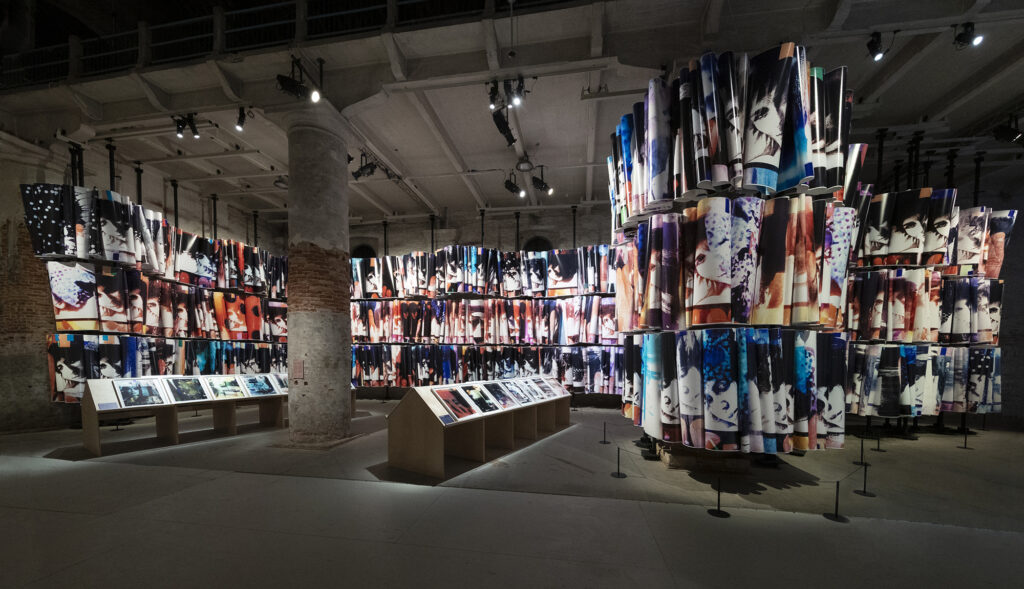
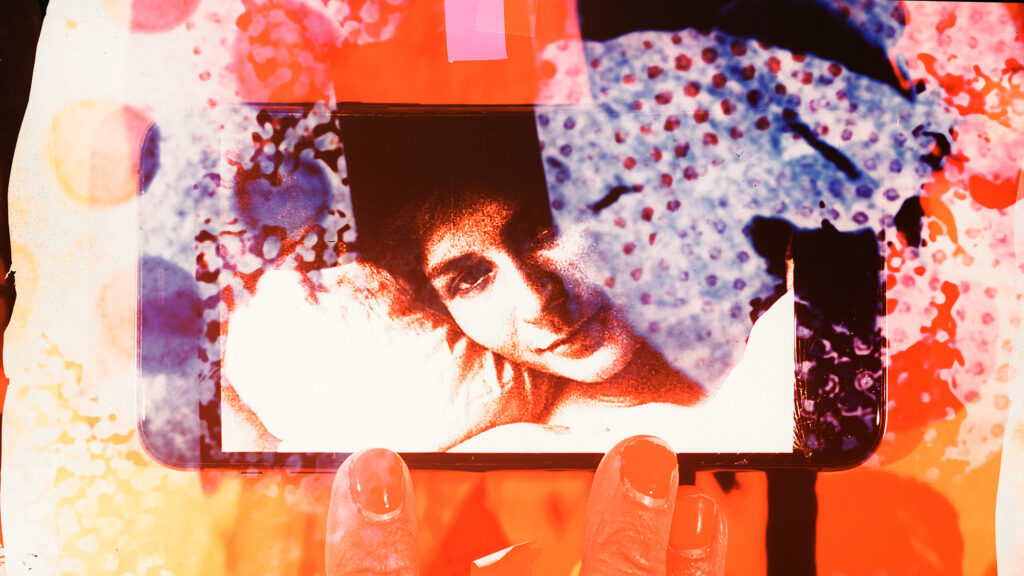
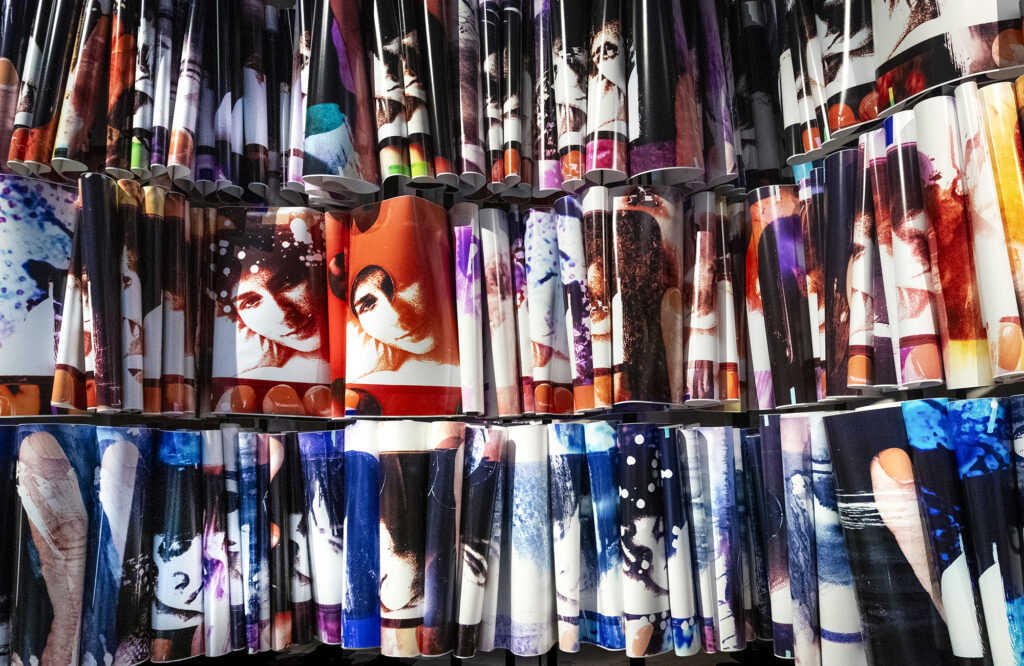
First Living Woman takes this moment of movement, which dazzles not despite but because of how small and fleeting it is, and returns it to a photographic eternity made monumental. Schneider played back a few seconds snatched from Marker’s tale of looping time on her iPhone, creating paper negatives that she then exposed frame-by-frame onto an expanse of chromogenic paper, the factory-standard size of Fujifilm’s jumbo roll, to create a richly layered positive. The exposed roll was then sent to Vienna to be processed, since no US lab was willing to attempt the difficult feat of printing. In Venice’s Arsenale, the results of this undertaking appear as three curving rows of serpentine ruffle that amount to a kilometer in length when taken together. Châtelain’s face is there again and again in serial form, as if a filmstrip had been unspooled and then coaxed into an irregular, creaseless concertina, held in place with magnets. Although Schneider makes use of a clip found online—a relic of private, digital fandom—her use of iteration evokes the material substrate of photochemical film, recalling that La Jetée’s exceptional few seconds of animation, like all filmic images, are at their base nothing other than a series of frozen frames. This relation to the moving image is concretized in the further iteration of First Living Woman, shown simultaneously in New York at David Peter Francis Gallery, which reanimates Châtelain within a looping Super 16mm film.
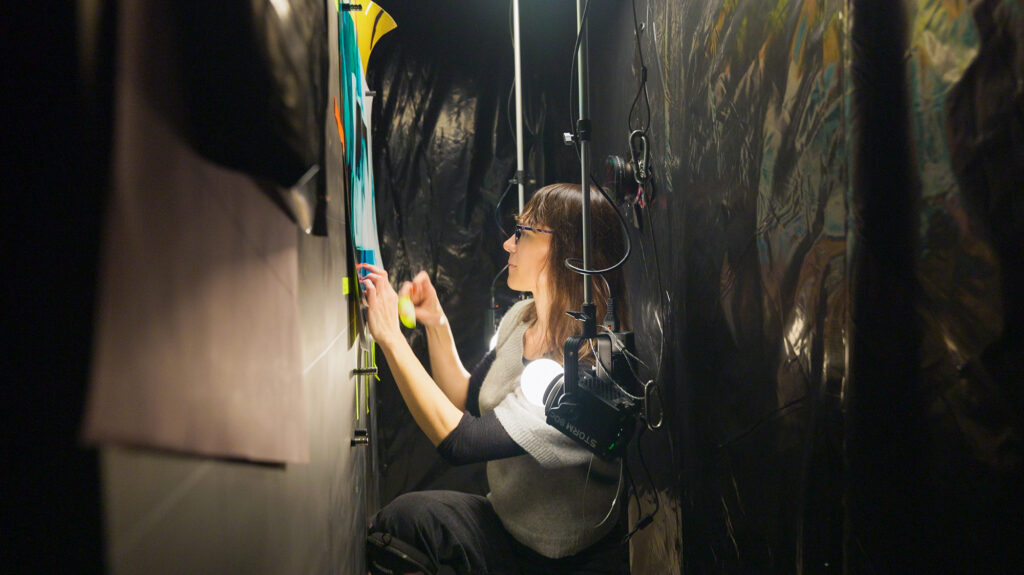
Across the many folds of the installation in Venice, the blinking woman from peacetime stares out from an iPhone screen held in place by hands with nails lacquered in orange—part of the palette of vibrant color Schneider uses to rework La Jetée’s black-and-white images and an index of her intimate encounter with the material. Châtelain is sometimes more, sometimes less visible, whether because she is hidden within the buckles of the paper or because of the manifold manipulations to which Schneider has subjected her image. She is awash in paint, punctured by holes, affixed with bits of tape, cut into confetti pieces that resemble digital artifacts but importantly are not. A whole vocabulary of analog operations has been brought to bear on these images of a YouTube bootleg of a 16mm film playing on a digital device, putting photography’s graphic and painterly dimensions into play alongside the ghostly haunting of the trace. If this layered density at times makes it difficult to discern precisely how Schneider has worked her darkroom wonders, something of a tutor text can be found in the single frames of her Deep Like (2020–21) series, selections from which are displayed in Venice on study tables in front First Living Woman, offering the visitor a more anatomized encounter with the various elements of what Schneider has called her “alphabet.”
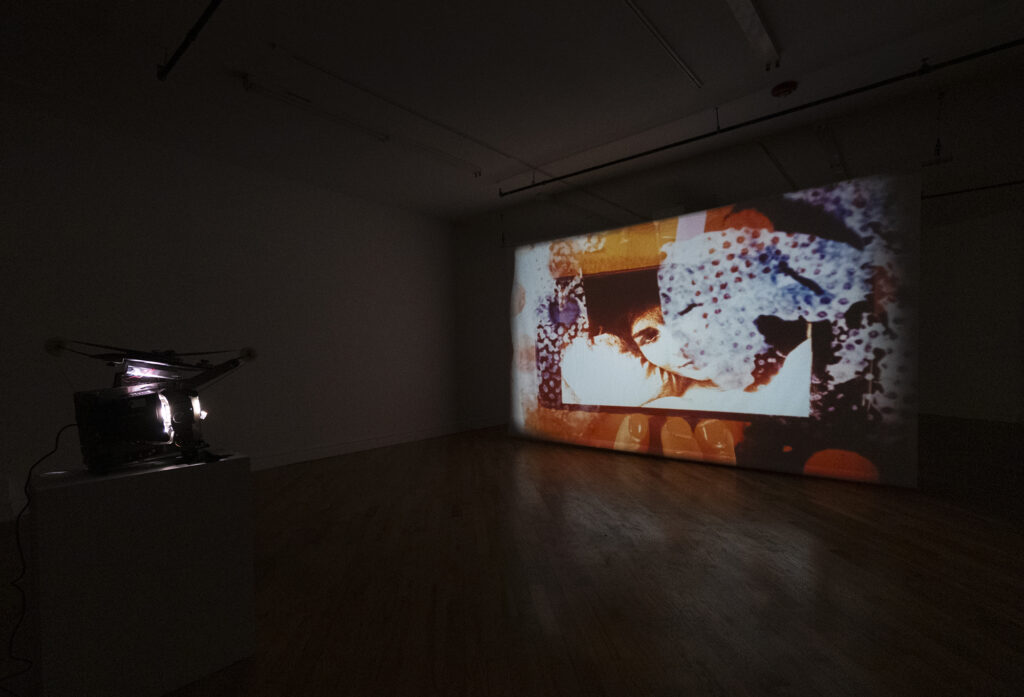
That this alphabet is so avowedly analog endows the installation with a posture of recalcitrance vis-à-vis the homogenizing thrust of digital imaging tools. Seen on an iPhone screen, Châtelain is an emblem of a remediated cinema without walls, one which is made miniature and possessable, able to be paused and endlessly relayed. Schneider pulls her out of this digital flood, rematerializing her image within a play of volume that denies all regularity and exceeds the small frame of the phone and laptop screen. If the scale of First Living Woman is commanding, it is without any hint of the flat slickness of billboard format. The installation is an architectural mass of prepossessing tactility, graced with a sensuousness that feels like a critical rejoinder to the crispness of the overlapping desktop windows that appear in another work of painted fingernails, Camille Henrot’s 2013 video Grosse Fatigue, which was on view in the same venue thirteen years ago in Massimiliano Gioni’s Biennale exhibition The Encyclopedic Palace.
All images courtesy the artist and David Peter Francis, New York
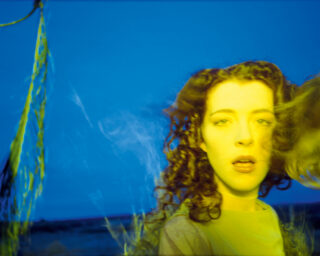
As Marker did before her, Schneider fixates on the female countenance as a site of revelation and affective intensity. The motif is not new for the artist: Her previous projects used similar in-camera processes to engage with the faces of Romy Schneider and Mariah Carey. But unlike them, Châtelain is no kind of celebrity. Even if she is the star of a cult classic so beloved that cinephiles the world over make pilgrimages to the Tokyo bar named for it, the replication of her image remains far from the brew of spectacle, technology, and commodification that simmers in the earlier works, imparting to them the flavor of rescue missions. First Living Woman carries forward Schneider’s interest in producing photographic monuments to fascinating female performers while introducing a new set of concerns that radiate from the specificity of her source material. It is never clear in La Jetée, purposefully so, whether Châtelain’s character is the mother, lover, or friend of the beleaguered protagonist. She is simply the one to whom he clings, the one who belongs to a time before catastrophe. Presented in a Biennale exhibition that searches for possibilities for rest and healing within modernity’s wreckage, and at a time when the war and environmental devastation of La Jetée feel less like a science-fiction plot than they do unnervingly real, Châtelain’s image figures as kind of talisman warding against darkness—an icon of longing for a lost, better time.
In Minor Keys, the 61st International Art Exhibition at the Venice Biennale, is on view through November 22, 2026.